This question about the fourth commandment is important, and many sincere believers wrestle with it. Below I will move slowly and methodically, showing from Scripture why Christians may worship on Sunday, why working on Saturday is not sinful, and how we still honor what God intended by the fourth commandment.
1) What the fourth commandment required, and to whom
Exodus 20:8–11 and Deuteronomy 5:12–15 command Israel to keep the seventh day holy, to rest from ordinary work, and to remember God’s creation and their redemption from Egypt. God later calls the Sabbath a covenant sign between Him and Israel, “throughout their generations” (Exodus 31:12-17; Ezekiel 20:12). Reason: the Sabbath under Moses was part of the specific covenant God made with Israel and served as a visible marker of that covenant. By the way, the same thing is true of circumcision.
2) What the law was for, and why it cannot justify us
Scripture teaches that the law exposes our sin and silences our excuses, not that it makes us righteous. See Romans 3:19, Galatians 2:16, 3:10–12, and James 2:10. Reason: the law’s standard is perfect and comprehensive; therefore, it condemns lawbreakers and drives us to Christ, it does not save us.
3) Christ, our Passover Lamb, brings a better sacrifice and a better covenant
Jesus fulfills the sacrificial system and brings grace and truth in fullness. He is the Lamb of God who takes away the sin of the world (John 1:29; 1 Peter 1:19; Hebrews 9:14). The Word became flesh, and from His fullness we receive grace upon grace, for the law was given through Moses, but grace and truth came through Jesus Christ (John 1:14-17). Reason: what the law could not do, God did through the once for all sacrifice of His Son. Therefore, our standing with God rests on Christ’s finished work, not on our performance of Mosaic stipulations.
4) Why the Mosaic Sabbath does not bind the church
a) The new covenant changes our relationship to the Mosaic code. Christ is the end, that is, the goal and fulfillment, of the law for righteousness to everyone who believes (Romans 10:4). God has made the first covenant obsolete by establishing a better one in Christ (Hebrews 8:6-13; 2 Corinthians 3).
b) The apostles did not impose Sabbath keeping on Gentile believers. At the Jerusalem Council, when the church addressed what was required of Gentiles, Sabbath keeping was not commanded (Acts 15). Reason: if Sabbath observance were essential for Christians, Acts 15 is the most natural place to require it, yet it is absent.
c) Paul explicitly grants liberty regarding holy days. “Let no one pass judgment on you in questions of food or drink, or with regard to a festival or a new moon or a Sabbath. These are a shadow of the things to come, but the substance belongs to Christ” (Colossians 2:16-17). He also writes, “One person esteems one day as better than another, while another esteems all days alike. Each one should be fully convinced in his own mind” (Romans 14:5-6). Reason: Sabbaths pointed forward to Christ, and in Him the shadow gives way to the reality, so believers must not be judged for their practice regarding days.
5) Why Christians gather on the first day of the week
The earliest churches met on the first day, the day of Christ’s resurrection. Believers gathered to break bread on “the first day of the week” (Acts 20:7), and Paul instructed collections “on the first day of every week” (1 Corinthians 16:2). John speaks of being “in the Spirit on the Lord’s day” (Revelation 1:10). Reason: the church’s pattern is resurrection centered worship. Scripture never transfers the fourth commandment to Sunday as a legal requirement, yet it shows a consistent apostolic practice of first day gathering.
6) What the fourth commandment still teaches us as Christians
Although we are not under the Mosaic Sabbath law for righteousness or acceptance with God, the command reveals abiding wisdom. God built a rhythm of work and rest into creation. Rest, worship, and acts of mercy honor Him. Jesus, the Lord of the Sabbath, taught that works of necessity and mercy are fitting (Mark 2:27-28; Matthew 12:1-12). Reason: in Christ we are free from the letter of the Mosaic command, yet we gladly embrace the moral wisdom of regular rest and devoted worship.
7) Answering this question with reasons from Scripture
“How can we keep the fourth commandment if we worship on Sunday and need to work on Saturday, which is the Sabbath?”
First, you are saved by grace through faith in Christ, not by keeping the law, any part of it or all of it (Galatians 2:16; Ephesians 2:8-9). Your acceptance with God does not rise or fall with your Saturday schedule. Reason: the gospel grounds your peace with God in Christ’s blood, not in your calendar.
Second, the New Testament does not bind your conscience to a seventh day Sabbath under threat of judgment. Paul says do not let anyone judge you with respect to Sabbaths, since they are shadows fulfilled in Christ (Colossians 2:16-17). Reason: if God says others must not judge you for this, then you are free before Him.
Third, you should still practice the wisdom of rest and worship. Gather with Christ’s people on the Lord’s Day when possible, and, if your work requires Saturdays, set aside regular time for rest and worship as your circumstances allow. Reason: the pattern of one in seven for rest is good for human flourishing, and the church’s first day gathering is apostolic and Christ honoring.
Fourth, if your conscience is tender on this matter, walk in love and knowledge. Romans 14:5-6 teaches each believer to be fully convinced in his or her own mind, to honor the Lord with whatever day is observed, and to refuse judging the other. Reason: God cares about your faith and your love, not legalistic conformity.
8) A word tying this back to Christ our Passover
Jesus Christ, our Passover Lamb, has been sacrificed for us (1 Corinthians 5:7). He is the Lamb who takes away the sin of the world (John 1:29). The better sacrifice secures a better covenant and brings a better rest. Hebrews 4 speaks of a Sabbath rest that remains for the people of God, a rest we taste now by faith and will fully enjoy in glory. Reason: your truest Sabbath is a Person. You keep the spirit of the command when you rest your soul in Christ, cease from trying to earn God’s favor, and worship with His people in the freedom of the gospel.
- Prioritize weekly corporate worship, ordinarily on Sunday, the resurrection day.
- If your job demands Saturday work, do not fear that you are sinning. Take another regular day for physical rest and spiritual refreshment.
- Keep daily communion with the Lord in Scripture and prayer, since Christ Himself is your rest.
- Walk in charity toward believers who practice differently, and do not let anyone bind your conscience beyond Scripture.
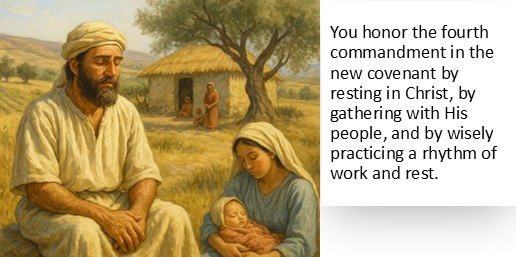
You honor the fourth commandment in the new covenant by resting in Christ, by gathering with His people, and by wisely practicing a rhythm of work and rest. You do not need to keep a legal seventh day Saturday to be faithful to God. Your righteousness is Christ, your Passover Lamb, who loved you and gave Himself for you.