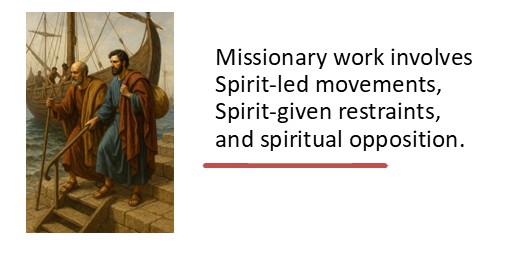
Missionary work has never followed a straight or predictable path. The New Testament reveals a rich tapestry of Spirit-led movements, Spirit-given restraints, and spiritual opposition. At times, God guides through unity. At other times, He overrules human conflict for good. For those seeking the will of God in missionary efforts today, these accounts offer profound clarity and encouragement.
1. The Spirit Leads Us Where God Wants Us
Jesus was “driven by the Spirit” into the wilderness and later ministered “in the power of the Spirit.” Philip was directed to a desert road and then to the Ethiopian’s chariot (Acts 8:26). Peter was told to go to Cornelius’s house (Acts 10:19-20). Paul and Barnabas were sent out from Antioch because the Spirit spoke to the church.
These examples remind us that God is not silent. He guides through Scripture, through the inward work of the Spirit, through godly counsel, and through providential circumstances. When we walk with Him, He places us exactly where He wants us to serve.
- The importance of being wind-blown instead of storm-tossed
- Acts 13 the most important inflection in the great commission
2. The Spirit Sometimes Redirects Our Plans
Paul was forbidden by the Spirit to preach in Asia (Acts 16:6) and was not permitted to enter Bithynia (Acts 16:7). Two closed doors led to the great open door in Macedonia (Acts 16:9-10), where the gospel reached Europe for the first time.
Not all closed doors are failures. Many are God’s merciful redirections.
His “no” always carries purpose. His “not here” often becomes “right there.”
3. The Spirit Even Works Through Disagreements
One of the most surprising movements of God in missions came through the sharp disagreement between Paul and Barnabas over John Mark (Acts 15:36–41).
Paul felt John Mark was not ready for the demands of the next journey, while Barnabas—the “son of encouragement”—believed in Mark’s potential and wanted to invest in him. Their disagreement became so strong that they parted ways.
Yet notice the fruit of God’s providence:
- Instead of one missionary team, there were now two.
- Barnabas took Mark to Cyprus, strengthening an earlier work.
- Paul took Silas through Syria and Cilicia, establishing new churches.
- In time, Mark matured and became “useful” to Paul (2 Timothy 4:11).
Though the disagreement was not ideal, God sovereignly used it to multiply missionary labor and develop future leaders.
The lesson is not to seek conflict, but to trust that God can work even through human weakness to accomplish His mission.
4. The Spirit Prepares Us for Hard Paths
Paul was “bound in the Spirit” to go to Jerusalem, even while the Spirit warned him through prophetic messages that suffering awaited. Obedience does not always lead to ease. Sometimes the Spirit leads us straight into difficulty for the sake of Christ.
But where the Spirit leads, He also strengthens.
5. The Enemy May Resist Us, But He Cannot Stop God
Paul confessed that “Satan hindered us” from visiting the Thessalonians (1 Thessalonians 2:18). Spiritual opposition is real. The devil hates gospel advance.
But Satan’s hindrance did not thwart the mission. God transformed that delay into opportunity, resulting in the letters of 1 and 2 Thessalonians.
The enemy may block a path, but he cannot block the purposes of God.
6. God’s Will Is Often Confirmed Through His People
The Spirit spoke to the church at Antioch (Acts 13). The Jerusalem Council acted under the conviction, “It seemed good to the Holy Spirit and to us.” The believers at Tyre shared Spirit-given warnings.
God commonly uses the gathered wisdom of Spirit-filled believers to confirm His leading. Mission is not meant to be isolated.
The Spirit leads us, but He often does so within the fellowship of the church (Acts 8:29; Acts 8:39-40).
- God-given dominion for self, family, community, church
- What about missionaries? Does God want you to be a missionary?
7. Following the Spirit Today
As you pursue missionary work or seek God’s direction in ministry, remember the full picture of how the Spirit guides:
- The Spirit sends.
- The Spirit stops.
- The Spirit strengthens.
- The Spirit warns.
- The Spirit even uses disagreements.
- The Spirit confirms through the church.
- And though Satan resists, God overrules.
Your task is not to engineer the mission, but to walk in step with the Spirit (Galatians 5:25), trusting that the same God who guided Jesus, Philip, Peter, Paul, Barnabas, and Mark will faithfully direct your steps today.