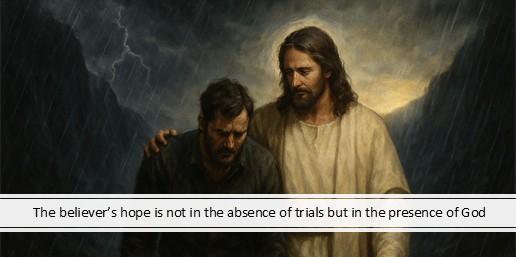
The Christian life is a journey filled with joys and hardships. God promises not a life free of trials, but a life where He is present in the midst of them. Psalm 23 and Romans 8:28-39, though written centuries apart, testify in harmony to this truth. David’s psalm comforts us with the picture of the Lord as our Shepherd, while Paul’s letter assures us of God’s unbreakable love in Christ. Together, these passages help us understand that storms will come, valleys must be walked, but God’s presence and purposes remain constant.
1. Christians Will Go Through Storms and Struggles
Psalms 23:4a: “Yea, though I walk through the valley of the shadow of death…”
Romans 8:35: “Who shall separate us from the love of Christ? Shall tribulation, or distress, or persecution, or famine, or nakedness, or peril, or sword?”
David does not say if he walks through the valley, but when. Paul likewise lists real hardships—tribulation, famine, persecution—that Christians in the first century and today must endure. Scripture consistently teaches that suffering is part of the believer’s walk.
-
Jesus Himself warned: “In the world ye shall have tribulation: but be of good cheer; I have overcome the world” (John 16:33).
-
Peter reminds believers not to be surprised “concerning the fiery trial” (1 Peter 4:12).
- The godly seek refuge from God when they see dangerous warning signs
The Christian life is not sheltered from storms but sustained through them. God’s Word is honest about suffering, yet always sets it within the larger frame of God’s faithfulness.
2. Sometimes It Will Seem Like We Have Been Abandoned
Psalms 23:4b: “…I will fear no evil: for thou art with me.”
Romans 8:36: “As it is written, For thy sake we are killed all the day long; we are accounted as sheep for the slaughter.”
There are seasons when believers feel forsaken. David knew this tension: he describes himself as a sheep walking through deep shadows, tempted to fear evil. Paul quotes Psalms 44, where God’s people lament that though they are faithful, they still face defeat and death.
This sense of abandonment was felt even by Christ on the cross: “My God, my God, why hast thou forsaken me?” (Matthew 27:46). Yet even there, the Father had not truly abandoned the Son. In the same way, our feelings of forsakenness never cancel God’s promises.
God’s people may cry out in pain, but faith learns to rest in His Word. “For he hath said, I will never leave thee, nor forsake thee” (Hebrews 13:5).
3. God Is With Us Through the Valley of Death
Psalms 23:4c: “…thy rod and thy staff they comfort me.”
Romans 8:38-39: “For I am persuaded, that neither death, nor life, … nor things present, nor things to come, … shall be able to separate us from the love of God, which is in Christ Jesus our Lord.”
The valley of the shadow of death is the most fearful valley. Yet David finds comfort in the Shepherd’s rod (protection) and staff (guidance). Paul likewise assures us that death itself cannot sever us from the love of Christ.
The Bible gives repeated examples of God’s presence in life’s darkest moments:
-
Joseph, falsely accused and imprisoned, later confessed, “God was with him” and turned evil to good (Genesis 39:21; 50:20).
-
Daniel in the lions’ den found the angel of the Lord shutting the lions’ mouths (Daniel 6:22).
-
Stephen, the first Christian martyr, saw Jesus standing at the right hand of God as he was stoned (Acts 7:55-56).
The Shepherd does not promise to keep us out of the valley, but to walk with us through it.
4. God Can Use These Times of Suffering for Our Good
Psalms 23:5-6: “Thou preparest a table before me in the presence of mine enemies… Surely goodness and mercy shall follow me all the days of my life.”
Romans 8:28: “And we know that all things work together for good to them that love God, to them who are the called according to his purpose.”
Psalms 23 concludes not in defeat but in overflowing blessing. Romans 8:28 gives the theological foundation: God orchestrates all things—even suffering—for the believer’s ultimate good, which is conformity to Christ (Romans 8:29).
-
Job’s trials, though excruciating, produced a deeper knowledge of God: “I have heard of thee by the hearing of the ear: but now mine eye seeth thee” (Job 42:5).
-
Paul’s thorn in the flesh taught him that God’s grace is sufficient, and His strength is made perfect in weakness (2 Corinthians 12:7-10).
- God has promised to deliver you
Suffering is never wasted in God’s plan. While not all things are good, God can weave them together for good, shaping us more into the image of His Son.
Conclusion: The Shepherd’s Love in the Storm
Psalms 23 and Romans 8:28-39 together remind us that the believer’s hope is not in the absence of trials but in the presence of God and the certainty of His love.
-
Yes, Christians will go through storms.
-
Yes, at times it will feel as though we are abandoned.
-
Yet in truth, God is always with us—even in death’s valley.
-
And He will use suffering to accomplish His good purposes in us.
The Shepherd’s rod and staff comfort us, and the unbreakable love of Christ assures us. Neither tribulation nor death, nor any power, can separate us from Him.
Therefore, like David we can say, “Surely goodness and mercy shall follow me all the days of my life,” and like Paul we can declare, “In all these things we are more than conquerors through him that loved us” (Romans 8:37).
Suggested Discussion Questions
-
How do Psalms 23 and Romans 8 help us balance honesty about suffering with confidence in God’s promises?
-
Why does God allow His people to pass through the valley instead of delivering them from every trial?
-
Can you think of a personal example where God used suffering for good in your life or the life of someone you know?
-
How can believers encourage one another to rest in God’s presence when trials feel overwhelming?