The Temptation Battlefield, the Enemy, and God’s Provision
Temptation is not merely an internal struggle with sinful desires, it is also a spiritual conflict in which a real adversary seeks to deceive, devour, and derail believers (1 Peter 5:8). Scripture teaches that Satan is a liar and deceiver (John 8:44), an accuser (Revelation 12:10), and a schemer who works through “wiles” (strategies) against the people of God (Ephesians 6:11).
Yet the Bible is equally clear that Christians are not left defenseless. God provides:
- The example of Jesus Christ’s victory in temptation (Matthew 4:1-11; Luke 4:1-13).
- The indwelling Holy Spirit, who empowers obedience and sanctification (Romans 8:13; Galatians 5:16).
- The Word of God, which equips and guards the believer (Psalms 119:11; 2 Timothy 3:16-17).
- The armor of God, enabling us to stand firm against Satan’s schemes (Ephesians 6:10-18).
- The promise that God provides a way of escape so we may endure (1 Corinthians 10:13).
This study works carefully through five consistent themes of Satanic temptation and shows how Jesus’ wilderness responses model a faithful, Spirit-empowered way of escape for the Christian.
Chapter 1
Questioning God’s Word
The Temptation: Undermining Trust in What God Has Said
The first temptation recorded in Scripture begins with a question aimed at destabilizing confidence in God’s Word:
“Yea, hath God said…?” (Genesis 3:1)
Notice the strategy. Satan did not begin by openly denying God. He began by casting suspicion on God’s clarity and goodness. In Genesis 3:1-5 he shifts from questioning God’s Word, to reframing it, to contradicting it:
- He questions: “Hath God said…?”
- He distorts: “Ye shall not eat of every tree…” (implying God is restrictive).
- He denies: “Ye shall not surely die” (Genesis 3:4).
- He reinterprets God’s motive: “God doth know…” (Genesis 3:5).
This pattern repeats throughout the Bible. Satan’s most effective lies often begin with small doubts that lead to large disobedience.
Scripture warns that false teachers and spiritual deceivers use similar tactics, twisting truth and confusing God’s people (2 Corinthians 11:13-15; 2 Peter 2:1-3). Paul feared that believers could be “beguiled” as Eve was, moved away from simple devotion to Christ (2 Corinthians 11:3).
Jesus’ Victory: “It Is Written” and the Authority of Scripture
In the wilderness, Jesus responds to Satan with Scripture, not speculation:
“It is written…” (Matthew 4:4, 7, 10)
When Satan tempts Jesus to make bread from stones, Jesus replies:
“Man shall not live by bread alone, but by every word that proceedeth out of the mouth of God” (Matthew 4:4; quoting Deuteronomy 8:3).
Christ demonstrates a foundational truth: spiritual life and faithful obedience are sustained by God’s Word. He refuses to let circumstances define reality. The Word of God defines reality.
The Christian’s Way of Escape: Spirit-Empowered Confidence in the Word
God does not call the Christian to resist temptation by willpower alone. Scripture teaches that victory is connected to:
- The Holy Spirit’s enabling power (Galatians 5:16).
- A renewed mind shaped by truth (Romans 12:1-2).
- The Word of God stored in the heart (Psalms 119:11).
Jesus’ “It is written” becomes a model for the believer. The Holy Spirit does not replace the Word, He illumines it, brings it to remembrance, and applies it to the heart (John 14:26; 16:13). A Christian who neglects Scripture will be vulnerable to doubts and distortions. A Christian who abides in Scripture will recognize and reject the subtle lie.
The Armor of God in This Battle (Ephesians 6:10-18)
When temptation begins by questioning God’s Word, the armor particularly speaks:
- Belt of truth: stabilizes the life around what God has revealed, not what Satan suggests (Ephesians 6:14; John 17:17).
- Shield of faith: extinguishes “fiery darts,” including doubts and insinuations about God’s character (Ephesians 6:16).
- Sword of the Spirit, which is the Word of God: the offensive and defensive weapon used as Jesus used it, rightly applied Scripture (Ephesians 6:17).
Discussion Questions
- Why is “Hath God said?” still one of Satan’s most effective strategies?
- What is the difference between honest questions and faith-undermining doubt?
- How does the Holy Spirit help a believer use Scripture in real-time temptation (John 14:26)?
- Which piece of the armor of God most directly addresses this temptation, and why?
Chapter 2
Appealing to Pride or Desire
The Temptation: Legitimate Desires Twisted into Disobedience
Satan tempts through desire by promising satisfaction outside God’s will. In Eden, Eve “saw” that the tree was good for food, pleasant to the eyes, and desired to make one wise (Genesis 3:6). The desire itself is not presented as sinful, but the desire became sinful when it governed her above God’s command.
The Bible explains the inward process of temptation:
“Every man is tempted, when he is drawn away of his own lust, and enticed” (James 1:14).
Then lust, when it is embraced, produces sin (James 1:15).
Pride is often intertwined with desire. Satan promised Eve elevation: “Ye shall be as gods” (Genesis 3:5). Pride seeks rule, independence, self-definition, self-exaltation.
Scripture gives sobering examples:
- David’s numbering of Israel was provoked by Satan (1 Chronicles 21:1), connected to pride and self-reliance.
- David and Bathsheba displays desire ungoverned by fear of God (2 Samuel 11).
- Judas shows desire for money, feeding betrayal (John 12:4-6; Luke 22:3-6).
John summarizes the categories of this temptation:
“The lust of the flesh, and the lust of the eyes, and the pride of life” (1 John 2:16).
Jesus’ Victory: Obedience Above Appetite, Humility Above Self-Assertion
In the wilderness, Jesus was hungry (Matthew 4:2). Satan tempts Him:
“If thou be the Son of God, command that these stones be made bread” (Matthew 4:3).
The temptation is subtle. It appeals to a legitimate need (hunger) and wraps it in an identity challenge (“If thou be…”). Satan suggests that Jesus should use power independently, apart from the Father’s will.
Jesus refuses. He chooses obedience above appetite. He anchors Himself in Scripture and submission:
“Man shall not live by bread alone…” (Matthew 4:4).
Jesus demonstrates that the issue is not whether bread is good, but whether obedience is supreme. He will not satisfy legitimate desires through illegitimate means.
The Christian’s Way of Escape: Walking in the Spirit, Mortifying the Flesh
The Christian’s victory over disordered desire is not achieved by merely suppressing temptation. Scripture teaches a better path:
- “Walk in the Spirit, and ye shall not fulfil the lust of the flesh” (Galatians 5:16).
- “If ye through the Spirit do mortify the deeds of the body, ye shall live” (Romans 8:13).
The Holy Spirit empowers a new pattern of life. He produces godly fruit (Galatians 5:22-23), strengthens inward man (Ephesians 3:16), and enables believers to present their bodies as living sacrifices (Romans 12:1).
The “way of escape” often looks like:
- refusing to be ruled by appetite (Philippians 3:19 warns against being ruled by “belly”),
- fleeing certain lusts (2 Timothy 2:22),
- replacing sinful desire with a superior affection for Christ (Colossians 3:1-5).
The Armor of God in This Battle
Desire and pride are fought by:
- Breastplate of righteousness: guards the heart and affections, reinforcing a life that chooses what is right (Ephesians 6:14).
- Helmet of salvation: protects the mind with assurance and identity rooted in God’s saving work, not Satan’s identity attacks (Ephesians 6:17).
- Shield of faith: refuses Satan’s promise of satisfaction apart from God, trusting God’s goodness and timing (Ephesians 6:16).
Discussion Questions
- How does Satan turn legitimate desires into sinful action?
- Why is identity (“If thou be…”) often tied to temptation?
- What does “walk in the Spirit” practically look like during a moment of temptation (Galatians 5:16)?
- How do righteousness and assurance function like armor in this area (Ephesians 6:14, 17)?
Chapter 3
Exploiting Fear or Pressure
The Temptation: Compromise Under Threat, Shame, or Urgency
Fear is a powerful lever. Satan uses pressure to move believers toward compromise:
- Fear of rejection
- Fear of loss
- Fear of suffering
- Fear of man
Peter’s denial shows how fear can overwhelm bold intentions (Matthew 26:69-75). Jesus explicitly identifies Satan’s assault:
“Satan hath desired to have you, that he may sift you as wheat” (Luke 22:31).
“Fearing man” can trap the soul:
“The fear of man bringeth a snare” (Proverbs 29:25).
Pressure also tempts believers into urgent decisions that bypass prayer, counsel, and Scripture. Israel repeatedly fell into unbelief under pressure, forgetting God’s works (Numbers 14; Psalms 78).
Jesus’ Victory: Worship and Allegiance That Cannot Be Bought
Satan offers Jesus “all the kingdoms of the world” (Matthew 4:8-9), but at a price: worship. This is a temptation toward compromise under the pressure of pain avoidance and instant authority. It is the offer of glory without suffering.
Jesus answers:
“Thou shalt worship the Lord thy God, and him only shalt thou serve” (Matthew 4:10; Deuteronomy 6:13).
Christ’s victory here is allegiance. He refuses a bargain. He will follow the Father’s will, even when it leads to the cross (Luke 22:42).
The Christian’s Way of Escape: Fear of God, Not Fear of Man
The Holy Spirit strengthens courage and endurance:
“God hath not given us the spirit of fear; but of power, and of love, and of a sound mind” (2 Timothy 1:7).
Believers endure pressure by remembering:
- God’s sovereignty (Romans 8:28-39),
- Christ’s presence (Matthew 28:20),
- eternal reward (2 Corinthians 4:16-18),
- and the call to faithful confession of Christ (Matthew 10:32-33).
Sometimes the escape is not removal from pressure, but strength to stand within it.
The Armor of God in This Battle
Pressure and fear are met by:
- Shoes of the preparation of the gospel of peace: steadiness that comes from reconciliation with God and readiness to stand firm (Ephesians 6:15; Romans 5:1).
- Shield of faith: extinguishes fear-driven darts that say, “God will not hold you,” or “You must compromise to survive” (Ephesians 6:16).
- Prayer: “praying always” is not a decorative addition, it is constant dependence during assault (Ephesians 6:18).
Discussion Questions
- In what ways does fear most commonly tempt believers to compromise?
- What does it mean to fear God rightly, and how does it break the fear of man (Proverbs 29:25)?
- How does worship function as resistance to temptation (Matthew 4:10)?
- Which parts of the armor are most comforting when you feel pressure, and why?
Chapter 4
Offering Shortcuts to Blessing
The Temptation: The Crown Without the Cross
Satan frequently offers a “good” end through sinful means. This is the temptation of shortcut religion:
- Blessing without obedience
- Success without integrity
- Fruit without abiding
- Power without submission
- Glory without suffering
In Matthew 4:5-6 Satan tempts Jesus to jump from the temple, quoting Psalms 91 to suggest God must protect Him. This is a temptation toward presumption, forcing God’s hand to gain public proof and instant validation.
Jesus’ Victory: Scripture Interpreted by Scripture, Faith Without Presumption
Jesus responds:
“It is written again, Thou shalt not tempt the Lord thy God” (Matthew 4:7; Deuteronomy 6:16).
Jesus shows that:
- Satan can quote Scripture.
- Quoting Scripture is not the same as obeying it.
- Scripture must be understood in context and harmony with all Scripture.
True faith trusts God. Presumption tests God.
The Christian’s Way of Escape: Patience, Obedience, and Biblical Discernment
The Holy Spirit leads believers into truth (John 16:13), cultivating wisdom and patience:
- “The fruit of the Spirit” includes self-control (Galatians 5:22-23).
- God produces endurance through trials (James 1:2-4).
- Believers are called to humble submission to God’s timing (1 Peter 5:6-7).
Many moral collapses begin with a shortcut. The Spirit’s path is steadier and slower, but it is safe and fruitful.
The Armor of God in This Battle
Shortcuts are resisted by:
- Belt of truth: keeps motives and methods aligned with what God has actually said (Ephesians 6:14).
- Breastplate of righteousness: protects from “ends justify the means” thinking, because righteousness cares about the path, not only the outcome (Ephesians 6:14).
- Sword of the Spirit: enables believers to answer misused Scripture with rightly understood Scripture (Ephesians 6:17).
Discussion Questions
- What are common “shortcuts” Christians are tempted to take today?
- How can you tell the difference between faith and presumption (Matthew 4:7)?
- Why is Satan’s misuse of Scripture particularly dangerous?
- How does righteousness protect your decision-making in morally complicated situations?
Chapter 5
Using Deception Masked as Truth
The Temptation: Error Disguised as Light
Satan’s most destructive temptations often look respectable:
“And no marvel; for Satan himself is transformed into an angel of light” (2 Corinthians 11:14).
He uses counterfeit righteousness (2 Corinthians 11:13-15), counterfeit gospels (Galatians 1:6-9), and deceptive teachings that blend truth with error.
This echoes Eden. The lie was not merely “disobey,” but “God is withholding good from you.” Deception frequently attacks God’s character and rebrands sin as freedom.
Jesus’ Victory: Discernment, Clarity, and Final Allegiance to God’s Word
Jesus recognizes Satan’s tactics immediately. He answers with Scripture rightly applied and refuses to enter Satan’s framing. He does not negotiate with deception.
This is a crucial lesson: the spiritually mature do not merely know Bible verses, they know how to interpret and apply them truthfully.
The Christian’s Way of Escape: Testing Spirits, Abiding in Truth, Walking in Light
Scripture commands discernment:
- “Try the spirits whether they are of God” (1 John 4:1).
- The Bereans were commended because they tested teaching by Scripture (Acts 17:11).
- Believers grow by receiving the Word with meekness and obeying it (James 1:21-22).
The Holy Spirit illumines truth and exposes error, but He does so through the Word He inspired (2 Peter 1:19-21). When believers remain in Scripture and obedience, deception loses its pull (John 7:17 teaches that willingness to do God’s will relates to discernment).
The Armor of God in This Battle
Deception is resisted by:
- Belt of truth: foundational integrity and doctrinal stability (Ephesians 6:14).
- Helmet of salvation: protects from identity confusion and gospel distortion (Ephesians 6:17).
- Sword of the Spirit: Scripture as the decisive instrument to expose lies (Ephesians 6:17).
- Prayer in the Spirit: ongoing dependence, alertness, and spiritual sobriety (Ephesians 6:18).
Discussion Questions
- Why is deception more dangerous than open persecution?
- How can Christians practice Acts 17:11 discernment without becoming cynical?
- What role does obedience play in spiritual clarity (James 1:22; John 7:17)?
- Which piece of the armor best addresses doctrinal confusion, and why?
Conclusion
Standing in Christ’s Victory, Clothed in God’s Armor
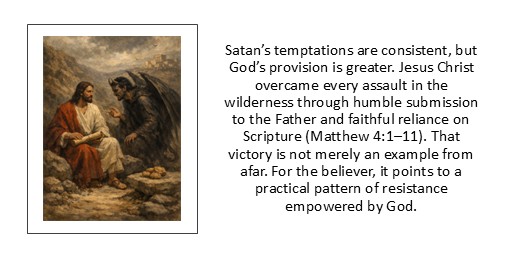
Satan’s temptations are consistent, but God’s provision is greater. Jesus Christ overcame every assault in the wilderness through humble submission to the Father and faithful reliance on Scripture (Matthew 4:1-11). That victory is not merely an example from afar. For the believer, it points to a practical pattern of resistance empowered by God.
God’s call is not merely to fight, but to stand:
“Be strong in the Lord, and in the power of his might” (Ephesians 6:10).
“Put on the whole armour of God, that ye may be able to stand against the wiles of the devil” (Ephesians 6:11).
Christ’s wilderness “It is written” teaches the Christian how to respond:
- When God’s Word is questioned, stand on truth.
- When pride and desire rise, submit to God and walk in the Spirit.
- When fear and pressure increase, worship God, trust Him, and refuse compromise.
- When shortcuts appear attractive, reject presumption and wait on God’s way.
- When deception masquerades as light, test everything by Scripture.
And in every case, believers lean on this promise:
“There hath no temptation taken you but such as is common to man: but God is faithful… will with the temptation also make a way to escape, that ye may be able to bear it” (1 Corinthians 10:13).
May the Lord use this study to deepen your confidence in His Word, strengthen your dependence on the Holy Spirit, and train your hands to stand firm in Christ’s victory.