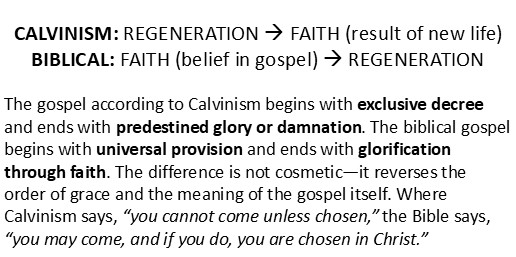
Let’s compare the gospel according to Calvinism against the gospel according to the Bible. I think the facts will show that Calvinism is not the gospel of the Bible. In fact it is so far removed from a Biblical gospel that I fear it should fall into the category of “other gospels” that the Apostle Paul warned should be accursed.
Let’s compare the gospel according to Calvinism with the gospel according to the Bible. These gospels are so different that I can’t do a simple table comparison because even the sequence of events is different in the gospel according to Calvinism.
Calvinist Plan of Salvation
I know this language will probably insult Calvinists but it does not distort Calvinism’s content — it simply removes its theological polish and replaces it with the blunt, moral tone of the prophets and apostles who exposed error by its fruits (Matthew 23:27; Galatians 1:8-9).
-
Before the world began, God decreed, by His unsearchable and unquestioned will, that countless souls would be made for damnation, and others for mercy — not for anything they would ever do, not for faith, not for repentance, not for love, but for His pleasure alone. The rest He passed over, consigning them to eternal ruin, that His wrath might display His glory (Romans 9:22-23).
-
God made mankind in His image, yet by divine plan, this humanity would soon be shattered. From Adam’s fall onward, every child of man would inherit guilt and corruption, unable even to lift a thought toward God, dead in trespasses — a graveyard of souls before they ever drew breath (Ephesians 2:1-3).
-
The Fall itself was no surprise but a decree, predetermined by the Almighty, who ordained that Adam would fall, that humanity might be enslaved to sin, so His electing grace might shine against the blackness of helpless ruin. Adam’s disobedience was certain, for nothing can thwart the eternal decree.
-
Christ came in time, not for the world, but for the chosen few. His blood was not shed for all sinners, though the gospel sounds to all ears. He bore not the sins of the world, but only of the secret elect whom the Father had already selected before the foundation of the world (John 10:14-15).
-
The rest of mankind, though hearing the gospel, can never believe it. The call of mercy is real to their ears but dead to their hearts, for God has withheld the power to respond. They stumble at the Word, being appointed to disobedience (1 Peter 2:8).
-
At a moment known only to God, the Spirit invades the heart of one of His elect. Though dead and unwilling, he is sovereignly resurrected. He is born again, not by hearing or believing first, but by God’s irresistible command. The will that once refused now obeys because it has been overruled. His faith is not his act but God’s creation within him (Philippians 1:29).
-
The sinner is forced to believe. The Almighty grants the gift of faith, forcing open blind eyes and deaf ears, causing the chosen soul to bow and believe. All others, no matter their tears or cries, remain fixed in unbelief, for the Lord of Heaven has not granted them life (John 6:37, 44).
-
Having compelled faith, God declares the elect righteous. They are justified, adopted, sealed, and secured — not because of repentance or trust freely given, but because divine fiat made it so. The transaction was settled before they were born; history merely catches up to the decree (Romans 8:29-30).
-
Those not chosen cannot fall from grace, for they never had it, and those chosen cannot fall away, no matter what they do. God restrains His elect from perishing, even if they are tempted by grievous sin, for their perseverance is not moral but mechanical — guaranteed by decree (John 10:28-29).
-
In the end, the elect will be glorified and brought to heaven, not because they believed in response to truth, but because they were pre-selected for glory before the dawn of time. The non-elect will burn forever, having been created for this very purpose — vessels of wrath fitted for destruction (Romans 9:22).
Biblical Plan of Salvation
This is the gospel according to the Bible. It is worded in the same prophetic style, but this time proclaiming the mercy, justice, and sincerity of God’s universal call — the “whosoever will” gospel of Scripture.
-
Before the world began, the Lord of Glory purposed that salvation would be in His Son. He foreknew those who would believe, yet did not decree their faith. His plan was set: that whoever believes in the Lamb would not perish but have everlasting life (John 3:16). The Almighty chose not a secret few, but a Savior for all (1 Timothy 2:4-6).
-
God created mankind in His image, not as puppets nor preprogrammed worshipers, but as beings capable of love, obedience, and faith. He gave Adam a real choice, and through Adam’s sin death entered the world (Romans 5:12), yet God’s purpose of grace did not die with him.
-
Though humanity fell, God’s heart remained open. He did not ordain rebellion but permitted it, that mercy might triumph over judgment. His Spirit still strove with man (Genesis 6:3); His voice still called, “Where art thou?” (Genesis 3:9).
-
At the fullness of time, the Word became flesh. Christ Jesus, the Lamb of God, came to take away the sin of the world (John 1:29). His cross was not a narrow door for a few, but the great gate of grace for all. He tasted death for every man (Hebrews 2:9) and purchased redemption sufficient for the entire race.
-
The gospel goes forth to all nations, commanding all men everywhere to repent (Acts 17:30). The trumpet of salvation sounds from Zion: “Look unto Me and be saved, all the ends of the earth” (Isaiah 45:22). The Spirit and the Bride still cry, “Come!” and whosoever will may come (Revelation 22:17).
-
The Spirit convicts and draws. He enlightens every man that comes into the world (John 1:9), persuading but not coercing, inviting but not violating. Grace woos; it does not wrestle the soul into submission. The sinner may resist (Acts 7:51), yet God’s call is sincere, and His mercy stands ready.
-
Faith arises from hearing the Word (Romans 10:17). The sinner, pierced by truth, may humble his heart and believe. To believe is not to boast, but to surrender. The hand that takes the free gift gives no glory to itself.
-
When the sinner believes, God gives new life. Regeneration follows faith, as the Spirit breathes into the trusting heart (John 20:31). The soul is born again, not by decree before belief, but by the Spirit through belief (Ephesians 1:13).
-
The believer is justified and adopted. God declares him righteous through Christ’s blood (Romans 5:1) and calls him “child” rather than “enemy.” The Spirit bears witness: “Abba, Father” (Romans 8:15).
-
Sanctification begins. The same grace that saves now teaches (Titus 2:11-12). The Spirit indwells, convicts, corrects, and empowers. Holiness is not automatic but relational — a daily yielding to the God who dwells within (Galatians 5:16).
-
Perseverance is commanded and secured. God keeps those who trust Him (John 10:28), yet He calls them to abide, to walk, to continue in the faith (Colossians 1:23). Salvation once received is eternally secure, but genuine faith will not make peace with sin (1 John 3:9).
-
At last comes glorification. The trumpet will sound, the dead in Christ shall rise, and every believer, once a vessel of mercy by faith, will shine with immortal glory (1 Corinthians 15:51-57). And the Judge of all the earth shall be vindicated: His justice untainted, His grace unrestricted, His invitation proven true — for none were shut out who would come, and none were lost except those who refused.
Where the gospel according to Calvinism paints the heavens as sealed and decrees as immovable, the gospel according to the Bible opens the gates wide: God’s heart yearning for all, Christ’s cross extending to all, and the Spirit calling all.
- What is the gospel?
- Your Sins Were Paid by the Death, Burial, and Resurrection of Jesus Christ
- Accepted in Christ, Transformed by Grace (Understanding Positional Acceptance and Progressive Sanctification)
- Faith and Works: Understanding Their Biblical Relationship
- The Security of the Believer (Safe in Christ)
- More impossible ways to lose your salvation