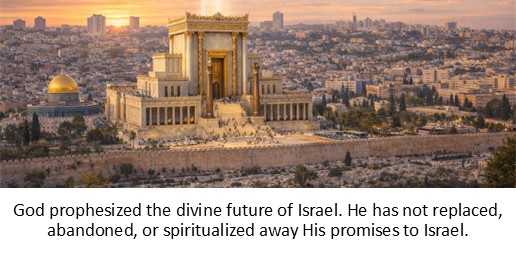
Few subjects in Scripture generate more discussion, misunderstanding, or theological confusion than the future of Israel. From Genesis to Revelation, God reveals a coherent, unfolding plan in which Israel occupies a central and enduring role. A literal, grammatical-historical reading of Scripture leads to the unavoidable conclusion that God has not finished with national Israel. Her past discipline, present partial blindness, and future restoration are all foretold in the Word of God.
This is not speculative prophecy or political commentary, but a careful, Scripture-centered examination of what God Himself has revealed. We will trace the major prophetic themes concerning Israel’s restoration, Jerusalem’s role, the Messiah’s reign, the New Covenant, and Israel’s future hope. Throughout, Scripture alone will be our authority.
God’s Covenant Commitment to Israel
Any discussion of Israel’s future must begin with God’s covenants. The Abrahamic Covenant (Genesis 12:1-3; 15:18–21), the Davidic Covenant (2 Samuel 7:12-16), and the New Covenant (Jeremiah 31:31-37) were made with a specific people, tied to a specific land, and guaranteed by God’s faithfulness, not Israel’s performance.
God repeatedly affirms that Israel’s preservation is rooted in His character:
“Thus says the LORD, who gives the sun for light by day… If this fixed order departs from before Me, declares the LORD, then shall the offspring of Israel cease from being a nation before Me forever” (Jeremiah 31:35-36).
- Eternal covenant promises for Israel from the Bible – A comprehensive list of the eternal covenant promises Almighty God has made to Israel and Jerusalem.
- Jesus Christ is the Rock of Israel – Jesus Christ is the Rock of Israel. The Old Testament prepared the way, Gospels revealed his person, and New Testament finished truth. He is the cornerstone.
- A brief history of the future – Share this brief history of the future as revealed in the Bible. It is a good introduction to eschatology, which is the study of end times.
Israel’s future is not optional, symbolic, or transferable. It is covenantal: pertaining to or established by a divine covenant, a solemn, binding, oath-based commitment initiated by God, whereby He obligates Himself to fulfill specific promises according to His character and purposes. In Scripture, a covenant (Hebrew berith) is not a mere contract between equals, but a sovereignly administered promise guaranteed by God’s faithfulness, often including defined parties, stipulations, blessings, and signs (Genesis 15:18; Jeremiah 31:31-37).
The Restoration of Israel to the Land
One of the most consistent prophetic themes in the Old Testament is Israel’s physical restoration to her land after dispersion among the nations. This regathering is presented as literal, geographical, and national.
Ezekiel writes:
“For I will take you from the nations and gather you from all the countries and bring you into your own land” (Ezekiel 36:24).
This promise is not merely spiritual renewal. The language is concrete and geographic. God speaks of “your land,” the same land promised to Abraham. The regathering precedes spiritual renewal, as seen in Ezekiel 36:25-27, where cleansing and a new heart follow the return.
Moses anticipated this restoration centuries earlier:
“The LORD your God will restore you from captivity… and He will gather you again from all the peoples where the LORD your God has scattered you” (Deuteronomy 30:3).
Israel’s future exaltation among the nations is also foretold. Deuteronomy 28:13 promises that Israel will be “the head and not the tail,” a condition never fully realized in her history, pointing to a future Messianic kingdom.
Jerusalem in God’s Prophetic Plan
Jerusalem is not merely a historical capital. It is the geographic and spiritual center of God’s future kingdom program.
Jesus Himself declared:
“Jerusalem will be trampled by the Gentiles until the times of the Gentiles are fulfilled” (Luke 21:24).
The word “until” implies a termination point. Gentile domination is temporary. Jerusalem will again function as the center of divine rule on earth.
Zechariah foretells a dramatic reversal:
“In those days ten men from the nations of every tongue will grasp the robe of a Jew, saying, ‘Let us go with you, for we have heard that God is with you’” (Zechariah 8:23).
Far from being abandoned, Jerusalem becomes the focal point of worship, instruction, and international peace during Messiah’s reign (Isaiah 2:2-4).
The Coming of the Messiah and Israel’s Redemption
Messianic prophecy lies at the heart of Israel’s future. The Old Testament presents two complementary portraits of Messiah: the suffering Servant and the reigning King.
Isaiah 53 describes Messiah bearing the sins of His people, rejected yet victorious through suffering. Micah 5:2 identifies His birthplace as Bethlehem, fulfilled literally in the birth of Jesus Christ.
The New Testament affirms that Jesus is the promised Messiah, yet also explains Israel’s present unbelief:
“A partial hardening has come upon Israel, until the fullness of the Gentiles has come in” (Romans 11:25).
- Jesus Christ is the Messiah
- Why Do the Scribes Say That Elijah Must Come First?
- Jesus Baptized by John the Baptist Looking Forward to the Crucifixion
This blindness is neither total nor permanent. Paul goes on to declare:
“And so all Israel will be saved” (Romans 11:26).
This future salvation occurs when Israel looks upon the One they pierced (Zechariah 12:10) and receives Him as King.
Messiah’s reign will be characterized by righteousness, justice, and peace:
“With righteousness He shall judge the poor… and the earth shall be full of the knowledge of the LORD” (Isaiah 11:4-9).
Crime, injustice, and war will cease under His rule. The God of peace will reign from Jerusalem.
The Fulfillment of Promises and the Rebirth of Israel
In 1948, Israel was reborn as a nation after nearly two thousand years of dispersion. While modern Israel is not the kingdom and does not yet reflect spiritual renewal, its existence is prophetically significant.
Isaiah asked:
“Can a land be born in one day? Can a nation be brought forth in one moment?” (Isaiah 66:8).
Never before in history had such a phenomenon occurred. Israel’s rebirth stands as a providential marker pointing toward future fulfillment, not its completion.
Scripture consistently presents restoration in stages: physical regathering first, followed by spiritual regeneration. The modern state of Israel aligns precisely with this biblical pattern.
The New Covenant with Israel
The New Covenant is explicitly made “with the house of Israel and the house of Judah” (Jeremiah 31:31). While the Church enjoys spiritual blessings of the New Covenant through union with Christ, the covenant itself awaits national fulfillment with Israel.
God promises:
“I will put My law within them, and I will write it on their hearts. And I will be their God, and they shall be My people” (Jeremiah 31:33).
The author of Hebrews quotes this passage at length (Hebrews 8:8-12; 10:16), affirming its certainty and future realization. The covenant includes spiritual transformation, forgiveness of sins, and intimate knowledge of the Lord on a national scale.
Importantly, God ties the New Covenant to Israel’s continued existence as a nation:
“If this covenant could fail, then Israel could cease to be a nation, but God explicitly denies that possibility” (Jeremiah 31:36).
Future Hope and Renewal in the Kingdom
Israel’s future extends beyond restoration to unprecedented renewal. The prophets describe a coming age marked by healing, peace, and restoration of creation itself.
Jeremiah declares:
“For behold, days are coming… when I will restore the fortunes of My people Israel and Judah” (Jeremiah 30:3).
Isaiah describes extended lifespans, restored health, and agricultural abundance:
“The youth shall die a hundred years old” (Isaiah 65:20).
War will cease entirely:
“They shall beat their swords into plowshares” (Isaiah 2:4).
The Millennial Kingdom will include a restored temple and priesthood (Ezekiel 40–48), not as a return to Mosaic salvation, but as memorial worship pointing back to the finished work of Christ.
Even creation itself will experience renewal, echoing Edenic conditions (Romans 8:19-22). The curse will be restrained, and the knowledge of the Lord will cover the earth.
Conclusion
The Bible’s prophetic testimony concerning Israel is clear, consistent, and covenantally grounded. God has not replaced Israel, abandoned Israel, or spiritualized away His promises to Israel. He has disciplined her, preserved her, and guaranteed her future.
Israel’s restoration magnifies God’s faithfulness, vindicates His Word, and prepares the stage for the visible reign of Jesus Christ. As believers, we are called not to speculate, but to study, believe, and worship the God who declares the end from the beginning.
“He who scattered Israel will gather him, and will keep him as a shepherd keeps his flock” (Jeremiah 31:10).
This future is not uncertain. It is written.
“The days are coming,” declares the LORD, “when this city will be rebuilt for Me, from the tower of Hananel to the Corner Gate. The measuring line will once again stretch out straight to the hill of Gareb and then turn toward Goah. The whole valley of the dead bodies and ashes, and all the fields as far as the Kidron Valley, to the corner of the Horse Gate to the east, will be holy to the LORD. It will never again be uprooted or demolished.” (Jeremiah 31:38-40)