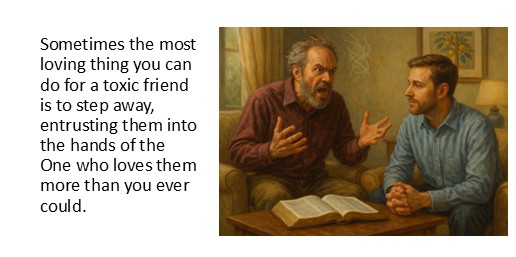
When Fellowship Hurts, Love Requires Distance
Friendship is one of God’s sweetest gifts. A faithful friend encourages you when you are weary, corrects you when you stray, and walks with you through both joy and sorrow. The book of Proverbs says, “A friend loves at all times, and a brother is born for adversity” (Proverbs 17:17).
But Scripture is also honest: some friendships, even among professing believers, can damage your walk with Christ. They can pull you into sin, distort your view of truth, divide the body of Christ, or numb your conscience. In such cases, the Bible does not tell us to “hang on no matter what.” Instead, it gives clear commands—sometimes urgent warnings—to step back.
Separation is not a failure of love; it is a form of love. It is the same love a shepherd shows when he pulls a sheep away from a cliff. It is the love that values a friend’s soul over the comfort of keeping things “pleasant.” And it is the love that values Christ’s honor above our own ease.
In the pages that follow, we will walk through ten biblical reasons to leave a toxic Christian friendship. Each one is rooted in Scripture, explained simply, and paired with a gracious phrase you can use when those difficult conversations come. You will see that leaving is not about revenge or bitterness—it’s about obedience, purity, and hope for repentance.
1. Persistent, Unrepentant Sin After Correction (1 Timothy 5:20; Titus 3:10-11)
One of the hardest moments in a Christian friendship is realizing a brother or sister is living in open sin and simply will not turn back. We all stumble (James 3:2), but there’s a difference between a momentary fall and a lifestyle of rebellion after repeated correction. Paul told Titus, “Reject a divisive man after a first and second admonition” (Titus 3:10). Jesus gave the same pattern in Matthew 18: first a private talk, then with witnesses, and finally involving the wider church.
If they refuse every appeal, continuing “normal” fellowship sends the wrong message—to them, to you, and to others watching. It risks normalizing what God calls sin. It can make you complicit in their rebellion, even if you don’t mean to be.
Stepping back is not about punishing or shaming them—it’s about loving them enough to draw a clear line. Sometimes, losing the closeness of fellowship is the wake-up call they need. And it’s also about guarding your own walk. Scripture says, “Do not be deceived: bad company corrupts good morals” (1 Corinthians 15:33).
This step must be taken slowly and prayerfully. Don’t act out of hurt pride or frustration. Search your own heart first (Galatians 6:1), then speak the truth gently but plainly. Let them know you are praying for their repentance and that you want restoration when they turn back to Christ.
Yes, you may be misunderstood. You may even be accused of being judgmental. But pleasing God comes before keeping people happy (Galatians 1:10). True love speaks truth, even when it risks the friendship.
Gracious phrase: “I care about you too much to pretend this is okay. Until this changes, I need to step back—for your good and mine.”
2. False Teaching That Corrupts the Gospel (Galatians 1:8-9; 1 Timothy 6:3-5; 2 John 1:10-11)
A false gospel isn’t just a “different perspective”—it’s deadly poison. Paul wrote with sobering urgency: “Even if we or an angel from heaven should preach a gospel contrary to the one we preached to you, let him be under a curse!” (Galatians 1:8). False teaching isn’t just an opinion you can “agree to disagree” on; it changes the very terms of salvation.
When a friend embraces or promotes such teaching, the stakes are eternal. The Bible’s instruction is clear: do not give them a platform, and do not extend fellowship in a way that signals agreement (2 John 1:10-11). This doesn’t mean you stop caring about them or praying for them. It means you refuse to partner with, promote, or endorse what they’re saying.
The temptation here is to keep the peace by saying nothing or quietly distancing yourself without explanation. But that’s not honest. If you have the opportunity, open Scripture together and test every claim (Acts 17:11). If they refuse correction and persist, you must walk away from any appearance of endorsing their message.
This may feel unkind, but it is actually the most loving choice. You are guarding the truth of the gospel and protecting others who might be swayed by error. Association matters—continued partnership can make you “a participant in their evil deeds” (2 John 1:11).
It’s possible to part ways without slamming the door. Make it clear your objection is to the false teaching, not a personal vendetta. Leave the path open for their return to sound doctrine.
Gracious phrase: “I care for you as a person, but I can’t stand with you in a message that contradicts God’s Word.”
3. Divisiveness and Faction-Making (Romans 16:17; 1 Corinthians 1:10; Titus 3:10-11)
Few things fracture a church more quickly than a person who stirs up division. Paul urged believers, “Watch out for those who cause divisions and obstacles contrary to the teaching you have learned; turn away from them” (Romans 16:17). This isn’t about healthy discussion or differing opinions—it’s about someone who thrives on stirring suspicion, pitting believers against each other, and rallying people to their “side.”
A divisive spirit erodes trust, distracts from the mission of the gospel, and drains spiritual energy. When a friend continually speaks against leaders, magnifies grievances, or frames every issue as a battle to win, it’s more than just personality—it’s sin. Titus 3:10-11 instructs us to give a first and second warning, then refuse further association if the person refuses to repent.
You can appeal with kindness: “Let’s unite around Scripture, not personal preferences.” But if they persist in fueling strife, your continued fellowship can feed the fire. Separation is sometimes the only way to stop enabling their behavior.
Walking away from a divisive friend can feel like betrayal, but staying often means becoming a participant in their divisiveness. God’s goal is not that we “agree on everything” in every detail, but that we remain united in truth and love (1 Corinthians 1:10). That unity cannot exist if someone is determined to tear it down.
Gracious phrase: “I value our friendship, but I can’t be part of conversations that damage unity in the body of Christ.”
4. Outward Religion Without Submission to God’s Power (2 Timothy 3:5)
Some people know all the right words, attend all the right gatherings, and even have the respect of their community—yet they resist the transforming work of God in their lives. Paul warns of those “having a form of godliness but denying its power. Turn away from such people” (2 Timothy 3:5).
This warning is sobering. Outward religion without inward change is like a beautifully wrapped gift box with nothing inside. It may look impressive, but it offers no life. Such friends might talk about faith, yet avoid obedience when it challenges their comfort or pride.
The danger here is subtle. Because they seem “good,” we can grow comfortable with a Christianity that has no power, slowly lowering our own spiritual expectations. But the Christian life is not about external rituals—it is about a living relationship with Christ that produces holiness.
This doesn’t mean abandoning every friend who struggles. We all wrestle with sin. The difference is between someone who fights their sin in the Spirit’s power and someone who refuses that power entirely. When a friend persistently chooses the latter, Paul’s command is clear: turn away.
Our motive is never to look down on them but to protect the integrity of our own walk and encourage them toward the real, transforming power of Christ.
Gracious phrase: “I want both of us to walk in a faith that’s alive and real—not just in appearances.”
5. Disorderly, Undisciplined Living That Rejects God’s Instruction (2 Thessalonians 3:6, 14–15)
Paul speaks plainly: “Keep away from any brother who is walking in idleness and not in accord with the tradition that you received from us” (2 Thessalonians 3:6). This isn’t about minor quirks or personal preferences—it’s about a pattern of living that openly rejects God’s Word.
Disorderly living spreads quickly. When a professing believer refuses godly counsel and ignores clear instruction from Scripture, their example can lead others down the same path. That’s why Paul commands believers to “take note of that person, and have nothing to do with him, that he may be ashamed” (verse 14).
Notice the balance: “Do not regard him as an enemy, but warn him as a brother” (verse 15). This kind of separation is not motivated by hostility but by a desire for repentance. We step back so the weight of their actions becomes real to them—so they feel the loss of fellowship and are moved to return to Christ.
It’s not easy, especially when accusations of being “unloving” fly. But love does not ignore sin. Love warns and, if necessary, withdraws so the other person can see the seriousness of their rebellion.
Gracious phrase: “I’m not against you, but I can’t ignore what God’s Word says about the way you’re living.”
6. Open, Scandalous Sins That Must Not Be Normalized (1 Corinthians 5:9-13)
Paul draws a clear line: “Do not even eat with such a one” (1 Corinthians 5:11) when a professing believer is living in sexual immorality, greed, idolatry, verbal abuse, drunkenness, or swindling.
We are called to reach unbelievers in the world who live in these ways—that’s expected. But when someone claims Christ and openly lives in such sins without repentance, the Bible tells us not to maintain normal fellowship.
Why? Because sin tolerated in the church will soon spread through the church. Paul uses the image of leaven working through dough to show how quickly corruption moves. It also confuses the watching world, making them think God accepts what He condemns.
This is not an act of self-righteousness; it is obedience to protect the holiness of God’s people. You may still check in, pray, or express your desire to see them restored—but you cannot continue as though nothing is wrong.
Gracious phrase: “Because you belong to Christ, He calls you to something better—and I can’t pretend this is okay.”
7. Blasphemy and Shipwrecked Faith That Harms Others (1 Timothy 1:19-20)
Paul names Hymenaeus and Alexander as men who “rejected… a good conscience” and “shipwrecked their faith.” His response? “I have handed them over to Satan that they may learn not to blaspheme.”
This was not personal revenge—it was protective discipline. Their false words and actions dishonored Christ and misled others. Allowing them to remain in fellowship would have signaled that such behavior was tolerable.
When someone’s influence actively turns others away from the truth of God, separation becomes necessary—not just for their sake, but for the sake of those who might follow them. This is why leaders must be willing to act decisively, and why individual believers must be willing to set clear boundaries.
The hope is always that such a step will awaken them to the seriousness of their sin and lead to repentance. But even if they do not repent, your action preserves the honor of Christ and the safety of His people.
Gracious phrase: “Your words are harming the name of Christ. I can’t walk with you in this until you turn back to Him.”
8. Quarrelsome, Speculative Controversies (2 Timothy 2:23-25)
Some friendships aren’t destroyed by scandal—they’re drained dry by endless arguments. Paul warns against “foolish and ignorant controversies” because “you know that they breed quarrels” (2 Timothy 2:23).
These are not healthy, sharpening discussions about Scripture. They’re pointless debates, hypothetical disputes, or heated opinions that never lead to growth. When every conversation turns into a fight, it poisons the friendship and distracts from the real work of loving God and others.
The servant of the Lord must “not be quarrelsome but kind to everyone… correcting his opponents with gentleness” (verses 24–25). That means refusing to be baited into constant conflict, even if you could “win” the argument.
Sometimes, the most Christlike thing you can say is, “I’m not going to keep going down this road.” Your silence can end a cycle of unprofitable talk and leave space for God to work in their heart.
Gracious phrase: “I’m happy to talk about God’s Word, but I won’t stay in endless debates that lead us nowhere.”
9. Treating Godliness as a Means of Personal Gain (1 Timothy 6:3-5)
Paul warns about those who “imagine that godliness is a means of gain” (1 Timothy 6:5). Whether it’s money, status, influence, or control, some people use ministry and spiritual appearance as tools for self-promotion.
The fruit of such motives is ugly—envy, strife, slander, and constant friction. Continuing in close partnership with someone like this can make you a silent partner in their misuse of God’s work. That’s why Paul says, “From such withdraw yourself.”
This kind of separation protects your integrity and prevents the spread of corruption in the church. It also sends a clear message: ministry is service to Christ, not a ladder for personal ambition.
If you must take this step, communicate your reasons without attacking their character. Focus on the principle—God’s work must be done God’s way, with a pure heart.
Gracious phrase: “I want to serve God together with a pure heart, and I can’t be part of something that turns service into self-promotion.”
10. Ongoing Association Makes You Share in Their Sin (2 John 1:10-11; 1 Corinthians 15:33)
Sometimes the issue is not only what the other person is doing but what your association communicates to others. John warns that even greeting a false teacher in a way that signals approval makes you “share in his evil deeds” (2 John 1:11).
This doesn’t mean you refuse basic courtesy—it means you do not publicly partner with, promote, or endorse those who reject God’s truth. The principle is simple: your fellowship is your endorsement.
When appeals for repentance go unanswered, and when continued association would imply agreement with error or sin, the only faithful choice is to step away.
Your hope is still for restoration, but your responsibility is to honor Christ and guard your own walk.
Gracious phrase: “I love you as a person, but for the sake of truth, I can’t be publicly connected with this.”
Conclusion — Love That Protects, Truth That Restores
Stepping away from a friendship is never easy—especially when that friend names the name of Christ. But our first loyalty is not to human approval; it is to the Lord who bought us with His blood. We honor Him when we protect the purity of His truth, guard the health of His people, and refuse to be drawn into the very sins He came to rescue us from.
Every reason we have examined flows from this reality: fellowship is not just about shared history or warm feelings; it is about walking together in the light (1 John 1:7). When a friend refuses that light—whether through sin, error, division, or misuse of the gospel—close fellowship is no longer possible without compromising the truth.
Yet even in separation, our posture remains hopeful. We pray for repentance. We stay ready for restoration. We remember that God’s grace can change any heart, just as He has changed ours.
Your obedience in this area may be misunderstood. It may even be painful. But the Lord sees, and He will honor those who honor Him. One day, either in this life or in the life to come, you will see the fruit of a choice made not out of fear or pride, but out of a deep love for God and for the souls He calls precious.
So guard your heart. Walk in truth. Speak with grace. And remember—sometimes the most loving thing you can do for a friend is to step away, entrusting them into the hands of the One who loves them more than you ever could.