Many assume that baptismal waters are what bring salvation, but the Bible teaches otherwise. Salvation is not found in a pool of water, but in a Person—Jesus Christ. The moment a sinner believes and calls upon the name of the Lord, he experiences what we could call a “dry baptism.” Without a drop of water, God cleanses the heart, forgives sin, and unites the believer to Christ. Baptism follows as an act of obedience and public confession, but salvation itself is secured through faith alone in Christ alone.
“That if thou shalt confess with thy mouth the Lord Jesus, and shalt believe in thine heart that God hath raised him from the dead, thou shalt be saved. For with the heart man believeth unto righteousness; and with the mouth confession is made unto salvation… For whosoever shall call upon the name of the Lord shall be saved.” (Romans 10:9–10, 13)
Many today confuse the outward act of water baptism with the inward reality of salvation. Yet the Bible is crystal clear: salvation comes by faith in Christ, not by ritual. When Paul recounts his own conversion in Acts 22:16, he was told, “Arise, and be baptized, and wash away thy sins, calling on the name of the Lord.” Notice carefully—the sins are washed away not by the water but by calling on the name of the Lord.
This is what we might call a “dry baptism.” It is the moment a sinner trusts Christ alone, without a drop of water, that God applies the cleansing of the blood of Jesus Christ. The Spirit unites the believer to Christ, forgives sins, and grants eternal life (John 5:24; Titus 3:5; 1 Corinthians 12:13). The water that follows is a testimony, not a condition.
Think of the thief on the cross. He had no chance for baptism. Yet in simple faith he cried out, “Lord, remember me when thou comest into thy kingdom.” Jesus assured him, “Today shalt thou be with me in paradise” (Luke 23:42-43). That was salvation by a dry baptism—trusting in Christ apart from any ceremony.
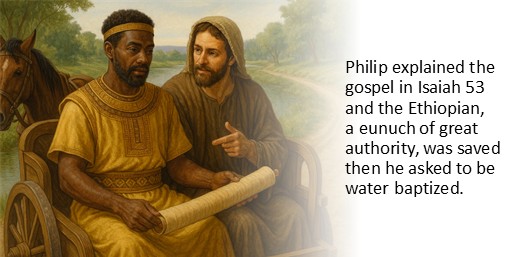
One of the most interesting accounts of salvation and water baptism is found in Acts 8. Philip is carried in the spirit to the desert where he encounters an Ethiopian eunuch of great authority. After the Ethiopian is saved by hearing the explanation of the gospel in Isaiah 53:7-8, then he asks if he can be water baptized.
Water baptism is good and commanded for every believer, but it cannot save. If it did, salvation would be by works, and grace would no longer be grace (Romans 11:6). Instead, the Scripture declares: “Whosoever shall call upon the name of the Lord shall be saved” (Romans 10:13).
Have you called upon the name of the Lord? Salvation is not about what you do for God, but about receiving what He has already done for you in Christ’s death and resurrection. Do not delay. Confess Him today as Lord and believe in your heart that God raised Him from the dead. That very moment, before ever entering a baptistry, you will be saved.
Reflection Questions
- Why is “calling on the name of the Lord” the true condition for salvation? (Romans 10:13)
- How does the example of the thief on the cross prove that water baptism is not required for salvation?
- How can you explain to others the difference between baptism as obedience and faith in Christ as salvation?