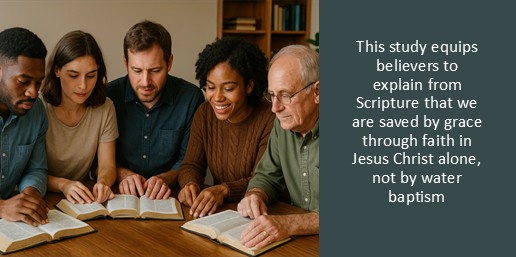
This study equips believers to explain from Scripture that we are saved by grace through faith in Jesus Christ alone, and that water baptism is an important act of obedience that follows salvation but does not cause it. It is suitable for a one‑to‑one conversation, a small group, or a class setting.
Big Idea
Christ saves sinners through faith apart from works. Water baptism publicly identifies a believer with Christ; it is a sign, not a savior.
How to Use This Study
Read the passages aloud. Ask the discussion questions. Keep the Bible open. Encourage participants to answer from the text. Close with prayer that points to trust in Christ alone.
Step 1. Define the Gospel God Actually Preaches
Primary readings: Ephesians 2:8-9; Romans 3:21-28; Titus 3:5; John 3:16; Acts 16:30-31; John 5:24.
Explanation: Scripture repeatedly states that salvation is a gift received through faith, not by works or rituals. The verbs are believe, receive, call, come. No passage makes a ritual a condition for receiving eternal life.
Key terms: grace (Greek charis, gift or favor), faith (pistis, trust or reliance), works (erga, deeds accomplished).
Questions to discuss: What saves according to these passages? If water baptism were required, would salvation still be “not of works” (Ephesians 2:9)? When does a person have eternal life according to John 5:24?
Step 2. Place Water Baptism Where the Apostles Place It
Primary readings: Acts 8:26-39; Acts 10:43-48; 1 Corinthians 1:14-18; Matthew 28:18-20.
Explanation: In Acts 8 and 10, people believe and receive the Holy Spirit first, then they are baptized. Paul distinguishes the gospel from the act of baptizing (1 Corinthians 1:17). In the Great Commission, water baptism is the first step of discipleship after one becomes a believer.
Questions to discuss: In Acts 10, did Cornelius receive the Holy Spirit before or after water baptism? If water baptism were necessary for salvation, how could Paul say “Christ did not send me to baptize, but to preach the gospel” (1 Corinthians 1:17)?
Step 3. Distinguish Spirit Baptism and Water Baptism
Primary readings: 1 Corinthians 12:13; Ephesians 1:13-14; Romans 6:3-4; Galatians 3:26-27.
Explanation: At the moment of faith, the Holy Spirit baptizes the believer into the body of Christ (1 Corinthians 12:13). This is a spiritual union with Christ’s death and resurrection (Romans 6:3-4). Water baptism is the outward testimony and picture of this inward reality. Do not confuse the sign with the thing signified.
Questions to discuss: According to Ephesians 1:13-14, when does a person receive the Spirit? What is pictured in Romans 6:3-4? Does the passage say the water performs the union, or that water baptism symbolizes a union already accomplished by Christ?
Other resources: What is Salvation Baptism?
Step 4. Handle the Common Proof Texts Carefully
A. Mark 16:16
Text: “He who believes and is baptized will be saved; but he who does not believe will be condemned.”
Explanation: The second clause shows unbelief condemns, not lack of water baptism. Where Scripture elsewhere gives the condition for eternal life, it is always faith in Christ. Note that many acknowledge verses 9-20 of Mark 16 are textually disputed; in any case, the theology remains consistent with the rest of Scripture.
Ask: What condemns in the verse? What consistently saves throughout the New Testament?
B. Acts 2:38
Text: “Repent, and be baptized every one of you in the name of Jesus Christ for the forgiveness of your sins…”
Explanation: The main command is “repent” (Greek metanoēsate, plural). “Be baptized” (baptisthētō, singular, “each of you”) is grammatically parenthetical. The phrase “for the forgiveness of your sins” most naturally links with the plural “repent.” Compare Acts 3:19, where repentance results in sins being wiped away. The preposition “for” (eis) can mean “with a view to,” “leading to,” or “because of” depending on context. Here the context of Acts and the grammar make repentance the condition for forgiveness, with baptism as the public identification that follows.
Ask: In the flow of Acts 2-3, what action brings forgiveness? When are water people baptized in Acts after believing?
C. John 3:5
Text: “Unless one is born of water and the Spirit, he cannot enter the kingdom of God.”
Explanation: Jesus is speaking to a teacher of Israel (Nicodemus) and alludes to Ezekiel 36:25-27, where God promises to sprinkle clean water and give a new heart and Spirit. The parallel in John 3:5-8 explains the new birth as a work of the Spirit. Nothing in the context introduces Christian water baptism, which was not yet instituted as a church ordinance. “Water and Spirit” describes one new‑covenant cleansing and renewal accomplished by the Spirit, not two steps, and not a ritual.
Ask: Where in the immediate context is water defined? What would Nicodemus, steeped in Ezekiel, have understood? How does John 3:6-8 restate verse 5?
D. 1 Peter 3:21
Text: “Baptism now saves you, not the removal of dirt from the flesh, but the answer (appeal) of a good conscience toward God, through the resurrection of Jesus Christ.”
Explanation: Peter explicitly denies that external water removes sin. He calls water baptism an antitype (Greek antitupon) corresponding to Noah’s deliverance. God saved Noah by placing him in the ark through judgment waters; the water itself was judgment. Baptism “saves” in the sense that it is the believer’s appeal to God based on Christ’s resurrection, the outward confession of the inward faith that actually saves. The saving cause is Christ’s resurrection, applied by faith.
Ask: What does Peter say baptism is not? According to the verse, through what are we saved?
E. Acts 22:16
Text: “And now why do you delay? Arise, be baptized, and wash away your sins, calling on His name.”
Explanation: The participle “calling on His name” (epikalesamenos) expresses the means by which sins are washed away. Throughout Acts, salvation comes by calling on the Lord (Acts 2:21; 9:14; Romans 10:13). Paul had already believed in Jesus on the road to Damascus and was now to be water baptized as a public confession of that faith.
Ask: According to Acts, how are sins washed away? Where else does “calling on the name of the Lord” describe receiving salvation?
Step 5. Confirm with Clear Case Studies
Primary readings: Luke 23:39-43; Acts 10:43-48; Galatians 1:6-9; 2:16; 3:2-3.
Explanation: The repentant thief received the promise of Paradise without baptism. Cornelius received the Holy Spirit before baptism. The Galatian error was adding any work to the gospel; Paul calls such additions “another gospel.”
Questions to discuss: What would have prevented the thief from being saved if baptism were required? What was Paul’s response to those who added works to faith in Christ?
Step 6. Embrace Water Baptism as Obedience, not as a Savior
Primary readings: Matthew 28:18-20; Acts 2:41; Romans 6:3-4.
Explanation: Baptism is commanded for disciples. It publicly identifies us with Christ in His death, burial, and resurrection, and with His people. It is a beautiful and necessary step of obedience, but it does not contribute to justification.
Questions to discuss: Why should a believer be baptized? What does baptism picture? How can we honor baptism without confusing it with the gospel?
Step 7. Call for a Clear Response to the Gospel
Primary readings: Romans 10:9-13; John 1:12; Ephesians 2:8-9.
Explanation: Invite the person to turn from self‑reliance and trust in the crucified and risen Lord Jesus Christ alone for the forgiveness of sins and the gift of eternal life. Encourage immediate baptism as a testimony after they believe.
Questions to discuss: What must a person do to be saved, according to these verses? When should a new believer be baptized, and why?
Key Doctrinal Summary
- Salvation is by grace alone through faith alone in Christ alone, apart from works (Ephesians 2:8-9; Romans 3:28; Titus 3:5).
- The Holy Spirit regenerates and indwells at the moment of faith (John 5:24; Ephesians 1:13-14; Titus 3:5).
- Water baptism follows salvation as a public identification with Christ and His people (Acts 8:36-38; Acts 10:47-48; Romans 6:3-4).
- Adding baptism, or any work, as a condition of justification distorts the gospel (Galatians 1:6-9; 2:16).
Word Studies and Notes
Metanoeō (repent): a decisive change of mind about sin and Christ that results in turning to Him (Acts 2:38; 3:19).
Baptizō (baptize): to immerse or dip; in the New Testament, the ordinance signifying identification with Christ (Acts 8:38-39).
Eis (for/into) in Acts 2:38: its meaning is determined by context; Acts links forgiveness to repentance and faith (compare Luke 24:46-47; Acts 3:19).
Loutron palingenesias (washing of regeneration) in Titus 3:5: inner cleansing and new birth by the Holy Spirit, not external water.
Antitupon (antitype) in 1 Peter 3:21: a corresponding figure; the emphasis is on what baptism represents, not on the physical water.
Eperōtēma (appeal/pledge) in 1 Peter 3:21: a sincere appeal or pledge to God from a good conscience grounded in Christ’s resurrection.
Leader Helps and Conversation Tips
Keep the person’s eyes on Jesus Christ and His finished work. Do not make water baptism small; make Christ great. Affirm the importance of obeying the Lord in water baptism after one believes. When objections arise, return to clear texts on grace through faith. Pray together, asking God for understanding and a heart to trust Christ alone.
Memory Verses to Hide in the Heart
Ephesians 2:8-9; Titus 3:5; John 5:24; Acts 16:31; Romans 10:9-10; 1 Corinthians 1:17.
Suggested Closing Prayer
Father, thank You for sending Your Son to die and rise again for our salvation. We confess that we cannot save ourselves. We trust in the Lord Jesus Christ alone for the forgiveness of sins and eternal life. Make us obedient disciples who gladly confess Christ in water baptism and follow Him all our days. In Jesus’ name, amen.
One‑Page Gospel Summary for Sharing
God is holy and we have all sinned. Jesus, fully God and fully man, died for our sins and rose again. God promises that whoever believes in Jesus has eternal life at once. This gift is received by grace through faith, not by works or rituals. After believing, we should be baptized as Christ’s disciples. Trust Christ today and then publicly confess Him in water baptism as an act of obedience and testimony.