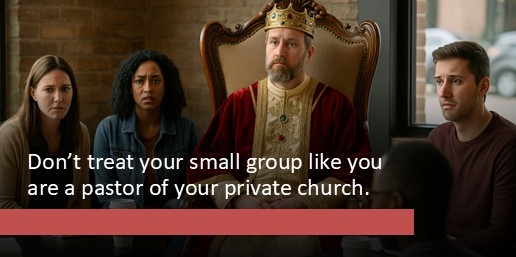
We love small groups because of the fellowship, community, and accountability of a tight-knit group of friends. But this can become a problem if you treat your small group like a private church. That may sound obvious, but it’s very important to remember as leaders. When we lose sight of it, we risk confusion, burnout, and even division. But when we honor God’s design, we serve with joy, clarity, and confidence. I pray that this study will reassure you of your purpose, encourage your walk, and remind you of cautions in God’s word.
Preach the word of God. Be prepared, whether the time is favorable or not. Patiently correct, rebuke, and encourage your people with good teaching. (2 Timothy 4:2)
Let’s open our Bibles and our hearts as we look at what Scripture says about our calling as small group leaders.
1. You Are a Peer Group Leader, Not the Pastor of a Private Church
Romans 12:4-5 says, “For as we have many members in one body, and all members have not the same office: so we, being many, are one body in Christ, and every one members one of another.”
We are one body with many members, but not everyone has the same role. God has given pastors and elders to shepherd the flock and oversee doctrine and direction. You, as small group leaders, serve as disciplers—guides who help others grow in the faith under that pastoral authority.
The small group leadership vetting process may prepare and equip you, but it does not ordain you to the pastoral office. Pastors carry a unique, God-given responsibility described in 1 Timothy 3 and Titus 1. Your calling is also vital—but it’s different. You are not called to shepherd a separate flock in a private church, but to make disciples within the flock God has already placed under His appointed shepherds.
When we remember that, it keeps us humble, it keeps us safe, and it keeps us united.
- Essential Skills and Competencies for Leading a Small Group
- Live like the humble savior who washed your feet
- Ten considerations before appointing church leaders
2. You Are Making Disciples, Not Shepherding a Flock
In Matthew 28:19-20, Jesus said, “Go therefore and make disciples of all nations… teaching them to observe all that I have commanded you.”
That’s your job description: to make disciples. You’re not building your own private church but participating in Christ’s great mission—helping believers learn, obey, and grow.
James 3:1 warns, “Be not many masters (teachers), knowing that we shall receive the greater condemnation.” Leadership brings accountability. So serve faithfully, but stay within the boundaries of what God has called you to do.
Disciple-making is about relationships, not rulership. It’s about spiritual growth, not spiritual control. You’re helping others follow Jesus, not following you.
- How will the world know you are my disciples?
- Five Crowns for Christian Believers
- Omotenashi and the Heart of Biblical Hospitality
3. No One Is Called to Counsel Everyone
Jay Adams once said, “No one is called to counsel everyone, but everyone is called to counsel someone.” That’s wise counsel for us as leaders.
Galatians 6:2 tells us, “Bear one another’s burdens, and so fulfill the law of Christ.” Yes, we’re to care deeply, to listen, to encourage, and to speak truth in love. But we must also recognize our limits. Some situations require the care of pastors, elders, or trained biblical counselors.
You are not meant to carry every burden alone. When someone in your group faces crisis or deep trauma, it’s not weakness to ask for help—it’s obedience. God gave the church many members for a reason, and one of them is so you don’t burn out trying to be everyone’s pastor.
4. You Are Responsible to Lead Faithfully
1 Peter 4:10-11 says, “As every man hath received the gift, even so minister the same one to another… If any man speak, let him speak as the oracles of God.”
Your leadership is a stewardship. It’s not casual, and it’s not optional. God calls you to lead every week with preparation, prayer, and purpose.
That means being ready to open the Word (2 Timothy 2:15), ready to correct, rebuke, and encourage (2 Timothy 4:2), and ready to guide your group with grace and truth. Faithfulness doesn’t mean perfection—it means consistency. It means showing up prepared, even when you’re tired, because you know the Lord is worth it.
1 Corinthians 4:2 says, “It is required in stewards, that a man be found faithful.” That’s our goal.
5. The Church Is Here to Support You
Ephesians 4:15-16 says, “Speaking the truth in love, we will in all things grow up into Christ Himself, who is the head. From Him the whole body, fitted and held together by every supporting ligament, grows and builds itself up in love through the work of each individual part.”
You are not alone. The local church exists to equip and support you. Pastors, deacons, counselors, and fellow leaders are here to walk with you.
You don’t have to carry the emotional or spiritual weight of ministry by yourself. We are one body, many parts, each doing our share. And when we work together, the body grows in love and maturity.
- Greetings from Paul (Discovering the Heart of the Apostle)
- Paul’s Prayers (Discovering the Heart of the Apostle)
6. The Authority and Unity of the Local Church
Small groups exist under the church’s authority, not beside it. Hebrews 13:17 reminds us to “obey them that have the rule over you, for they watch for your souls.”
Your group should always reinforce unity, not independence. Beware of subtle pride that says, “My group does things differently.” The moment a small group drifts from the doctrine or direction of the church, it becomes dangerous.
A healthy group is loyal to the Word, loyal to its pastors, and loyal to the mission. Remember, the goal is not to build our little kingdom but to build Christ’s kingdom together.
- What motivates you: arrogant pride or humble submission?
- God-given dominion for self, family, community, church
7. The Purpose and Limits of Small Groups
A small group is a supplement to the church, not a substitute for it.
Hebrews 10:25 commands us not to forsake assembling together. That means Sunday worship, corporate preaching, and the ordinances belong to the gathered church—not to our homes or small groups.
Small groups help believers connect, apply Scripture, and live on mission. Keep your group focused on discipleship, prayer, and outreach, all under church oversight.
8. The Character and Accountability of Leaders
Titus 2:7-8 says, “In all things showing thyself a pattern of good works: in doctrine showing uncorruptness, gravity, sincerity.”
Your character matters more than your communication skills. People will remember your humility, your patience, and your integrity long after they forget your discussion questions.
Maintain purity in relationships, especially across genders. Keep confidences wisely, but also avoid unstructured confession that can turn into gossip or misplaced dependence. Stay accountable to your pastors and to one another. Even those who restore others, Galatians 6:1 says, must watch themselves.
- The importance of a good Christian testimony
- Do you have Religious Trauma Syndrome?
- Lessons in the Wilderness: Warnings for the Church
9. Keep the Word and Prayer at the Center
Acts 2:42 tells us the early believers devoted themselves to the apostles’ teaching, to fellowship, to the breaking of bread, and to prayers.
That’s your pattern. Center your meetings on Scripture, not speculation. Lead with prayer, not personality. Encourage application, not just discussion. James 1:22 says, “Be doers of the word, and not hearers only.” A small group where people learn truth but never obey it misses the point.
And don’t neglect prayer. Real discipleship happens when the Word of God and the Spirit of God meet the people of God in humble dependence.
- How did the early church meet together?
- Principles of intercession, interceding, and intercessory prayer
- Obedience to God’s commands always leads to blessings and rewards
10. Servants Together in Christ’s Mission
1 Peter 5:4 calls Jesus the Chief Shepherd. That means every one of us—pastor, elder, or small group leader—serves under His authority. The people in your group are not your sheep. They are His.
Your task is to help them follow Him more closely, love Him more deeply, and obey Him more fully.
So, lead faithfully. Stay teachable. Depend on your pastors. Walk humbly with your God.
And remember this simple summary:
- Small groups are a ministry of the church, not a private church of their own.
- Leaders are disciple-makers under authority, not independent shepherds.
- The goal is unity in truth, maturity in Christ, and faithfulness to the Great Commission.
Closing Encouragement
1 Corinthians 15:58 says, “Therefore, my beloved brethren, be steadfast, unmovable, always abounding in the work of the Lord, forasmuch as ye know that your labour is not in vain in the Lord.”
Your labor—your preparation, your prayers, your care for people—none of it is wasted. God sees. God rewards. And God will use your obedience to build lives that last for eternity.
Let’s lead well. Let’s stay faithful. And let’s keep reminding ourselves and our groups: we are one church, serving one Lord, on one mission—to make disciples of Jesus Christ for the glory of God.