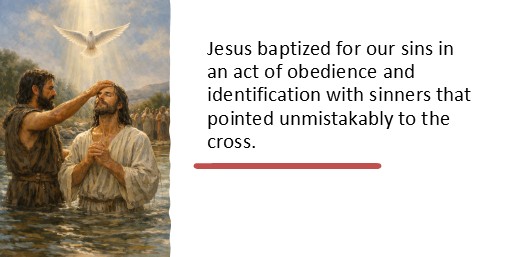
The baptism of Jesus Christ stands at the threshold of His public ministry. Though brief in description, especially in Luke’s Gospel, this event is rich in theological meaning. Jesus’ submission to John’s baptism was not an act of repentance for personal sin, for He was sinless. Rather, it was a deliberate act of identification with sinful humanity and a prophetic sign pointing forward to His redemptive work at the cross. Jesus’ baptism anticipates the crucifixion, reveals His identity, and establishes the pattern by which believers understand salvation and baptism today.
John’s Water Baptism Unto Repentance
John the Baptist preached “a baptism of repentance for the forgiveness of sins” (Luke 3:3). His baptism was preparatory, calling Israel to turn from sin in anticipation of the coming Messiah. It was not equivalent to Christian baptism nor to the Spirit’s work of regeneration. John’s ministry fulfilled Old Testament prophecy concerning a forerunner, commonly associated with Elijah. The scribes were correct to expect Elijah’s coming, but they erred in assuming a single, immediate fulfillment. John came “in the spirit and power of Elijah” (Luke 1:17), while Scripture also anticipates a future fulfillment associated with the Day of the Lord.
John’s baptism addressed sinful people who needed repentance. This creates an immediate theological tension when Jesus, the sinless Son of God, comes to be baptized.
The Sinless Christ Submits to Baptism
Jesus had no sins to confess. Scripture affirms repeatedly that He was without sin (Hebrews 4:15; 1 Peter 2:22). John recognized this and initially resisted baptizing Him, saying, “I need to be baptized by You, and do You come to me?” (Matthew 3:14). Jesus’ reply is crucial: “Permit it at this time; for in this way it is fitting for us to fulfill all righteousness” (Matthew 3:15).
When the time came, and the people were being baptized, Jesus came from Nazareth of Galilee to the Jordan River to be baptized by John. As Jesus approached him, John recognized who He was and declared, “Behold, the Lamb of God, who takes away the sin of the world. This is the One of whom I said, ‘He who comes after me has surpassed me, because He was before me.’”
John tried to prevent Him, saying, “I need to be baptized by You, and do You come to me?” But Jesus answered him, “Permit it at this time; for in this way it is fitting for us to fulfill all righteousness.” Then John consented.
So Jesus was baptized by John in the Jordan. And as soon as He came up out of the water, while He was praying, the heavens were opened. John saw the Spirit of God descending from heaven in bodily form, like a dove, and resting upon Him.
At that moment a voice came from heaven, saying, “You are My beloved Son; in You I am well pleased,” and also, “This is My beloved Son, in whom I am well pleased.”
John testified afterward, saying, “I myself did not know Him, but He who sent me to baptize with water said to me, ‘The One on whom you see the Spirit descend and remain, this is He who baptizes with the Holy Spirit.’ I have seen and have borne witness that this is the Son of God.” (Paraphrased from Matthew 3:13-17; Mark 1:9-11; Luke 3:21-22; John 1:29-34)
Jesus did not submit to baptism because He needed cleansing. He submitted in order to identify Himself with the sinners He came to save. By entering the waters of repentance, He publicly aligned Himself with sinful humanity. In doing so, He acted as their representative and intercessor.
Baptism, particularly by immersion, portrays death, burial, and resurrection. Jesus’ baptism therefore served as a visible, anticipatory sign of His coming “baptism” of suffering on the cross (Matthew 20:22; Luke 12:50). In this sense, His baptism looked forward to Calvary, where righteousness would be fully accomplished through His sacrificial death.
The Revelation of the Father and the Spirit
As Jesus came up from the water, heaven opened. The Holy Spirit descended upon Him in bodily form like a dove, and the Father’s voice declared, “You are My beloved Son, in You I am well pleased” (Luke 3:22). Here, the Triune God is clearly revealed. The Father affirms the Son, and the Spirit empowers Him for the ministry that lies ahead.
This moment marks the official beginning of Jesus’ public ministry. At about thirty years of age, the age when Levites entered service, Jesus was anointed by the Spirit and publicly approved by the Father. The declaration of divine pleasure did not rest on miracles performed or sermons preached, but on who Jesus is and His willing obedience to the Father’s redemptive plan.
This heavenly approval stands in deliberate contrast to what will later occur at the cross, where the beloved Son will bear the wrath of God for sinners and cry out, “My God, My God, why have You forsaken Me?” (Matthew 27:46). The baptism thus frames the entire ministry of Jesus between divine pleasure and sacrificial suffering.
Identity and Identification
Baptism is an act of identification. Scripture uses baptism language to describe union and allegiance, such as Israel being “baptized into Moses” (1 Corinthians 10:2) or believers being baptized “into Christ” (Romans 6:3). When Jesus was baptized, He identified Himself with those who needed repentance.
Luke places Jesus’ genealogy immediately after the account of His baptism. Tracing His lineage all the way back to Adam emphasizes His full identification with the whole human race. The genealogy is a record of fallen humanity, yet Jesus steps into that line as the sinless Son who stands where sinners stand.
He is the obedient Son where Adam failed and where Israel failed. The Father’s declaration confirms this truth: Jesus is the beloved Son who perfectly pleases God.
Looking Forward to the Cross
Jesus’ baptism foreshadows substitution. By going under the waters, He was saying, in effect, “Consider Me one of them.” That identification reaches its climax at the cross, where He truly becomes our substitute, bearing our sins in His body.
Scripture declares, “He made Him who knew no sin to be sin on our behalf, so that we might become the righteousness of God in Him” (2 Corinthians 5:21). The righteousness publicly affirmed at the baptism is the righteousness later credited to believers through faith, while the judgment absent at the baptism falls fully upon Christ at the cross.
The Finished Work of Christ
At Calvary, Jesus alone paid the penalty for the sins of the whole world. His death, burial, and resurrection constitute the finished work of redemption. Salvation is not achieved through ritual, effort, or moral reform, but through faith in Jesus Christ and His completed sacrifice.
United With Christ by Faith
When a person believes the gospel, they are spiritually united with Christ. Scripture teaches that believers are buried with Him and raised to new life through faith (Romans 6:3-5; Colossians 2:12). This union is accomplished by the Holy Spirit at the moment of salvation, not by water baptism.
The Meaning of Christian Water Baptism
Water baptism does not save. It is an act of obedience that symbolically declares what has already taken place through faith. Baptism pictures the believer’s identification with Christ in His death, burial, and resurrection. Just as Jesus’ baptism looked forward to the cross, the believer’s baptism looks back to it.
In this way, Christian baptism testifies to the gospel: Christ died for our sins, was buried, and rose again, and all who trust in Him share in that new life.
- Water Baptism Symbolizes Salvation – Water baptism symbolizes our death to sin, the washing away of our transgressions, and our resurrection to new life in Jesus Christ.
- What is Salvation Baptism? – Salvation baptism doesn’t have to be complicated. Here is an analysis of all verses with the verb or noun “baptism” and the preposition “into”.
- Five Crowns for Christian Believers – Five Biblical Crowns: Rewards for Faithfulness, Leadership, and Perseverance in the Christian Life through Bible Study and Spiritual Growth.
Conclusion
Jesus’ baptism by John was far more than an inauguration ceremony. It was a profound act of obedience and identification that pointed unmistakably to the cross. The sinless Son entered the waters of repentance to stand with sinners, anticipating the day He would stand in their place under judgment. For believers, this truth brings assurance, humility, and joy, for the One in whom the Father is well pleased has shared His righteousness with all who trust in Him.