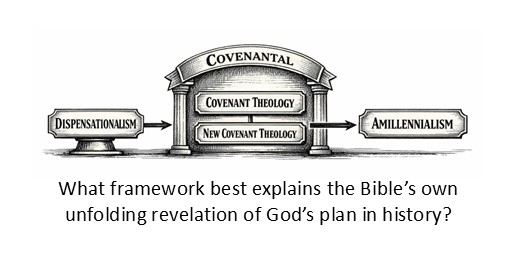
The biblical framework of “dispensationalism,” especially in its classic forms, has fallen out of favor in many academic and denominational circles. Seminaries that once taught it widely have shifted toward other systems. But it is important to ask a more fundamental question:
What framework best explains the Bible’s own unfolding revelation of God’s plan in history?
As a Christian under the authority of Scripture alone (2 Timothy 3:16-17; Jude 3), we must evaluate systems not by popularity, but by faithfulness to the grammatical-historical meaning of the text.
Let us first identify what has largely replaced Dispensationalism, then evaluate those systems biblically.
What Has Replaced Dispensationalism?
The primary system that has taken its place in many circles is Covenant Theology, often in Reformed traditions. In recent decades, a modified form called “New Covenant Theology” has also gained influence. In addition, Amillennialism has become the dominant eschatological framework in many evangelical institutions.
These systems share several common features:
- They see one overarching Covenant of Grace spanning redemptive history.
- They do not maintain a clear distinction between Israel and the Church.
- They interpret Old Testament kingdom promises typologically or spiritually rather than literally.
- They deny a future literal thousand-year reign of Christ on earth.
Let us examine these carefully.
1. Covenant Theology
Covenant Theology teaches that God has administered one Covenant of Grace throughout history, with different “administrations” but one unified redeemed people. Israel and the Church are seen as essentially the same people of God under different eras.
The Israel–Church question is the major dividing point. Whereas dispensationalism observes that:
- God made unconditional, literal promises to national Israel (Genesis 12:1-3; 2 Samuel 7:12-16; Jeremiah 31:31-37).
- Those promises include land, nationhood, throne, and kingdom.
- The Church began at Pentecost (Acts 2).
- The Church is not Israel (1 Corinthians 10:32).
Romans 11:25-29 states that Israel has experienced a partial hardening “until the fullness of the Gentiles has come in.” Then “all Israel will be saved.” Paul grounds this in the irrevocable nature of God’s covenant promises.
If Israel’s national promises are spiritualized into the Church, Paul’s argument collapses.
2. Amillennialism
Amillennialism denies a future literal thousand-year reign of Christ described in Revelation 20:1-6. It interprets the millennium symbolically as either:
- The present church age
- The “thousand years” represents a long, indefinite period rather than a literal duration.
- Christ is said to be reigning now from heaven at the Father’s right hand (Psalms 110:1).
- Satan is viewed as presently “bound” in the sense that he cannot prevent the spread of the gospel to the nations.
- The “first resurrection” is interpreted spiritually, often as regeneration or the believer’s entrance into heaven at death.
- The kingdom is understood primarily as Christ’s spiritual rule in the hearts of believers and through the Church.
- The eternal state
- Some interpret Revelation 20 as a symbolic recapitulation rather than a chronological sequence following Revelation 19.
- The millennium is equated with the final state of the redeemed rather than a distinct earthly kingdom.
- The Great White Throne judgment is seen as coinciding with Christ’s single, final return.
- No distinct future earthly reign of Christ from Jerusalem is expected prior to the new heavens and new earth.
In both forms, Amillennialism rejects a future, literal, earthly reign of Christ over national Israel and the nations for one thousand years prior to the eternal state.
But Revelation 20 repeats “a thousand years” six times. The grammatical-historical method requires us to interpret numbers literally unless context clearly demands symbolism.
Furthermore:
- Revelation 19 describes Christ’s visible return.
- Revelation 20 follows chronologically.
- Revelation 21–22 then describe the eternal state.
However, the natural reading presents:
- Christ returns.
- Satan is bound.
- Christ reigns 1,000 years.
- Final rebellion.
- Great White Throne judgment.
- New Heaven and New Earth.
Amillennialism disrupts this flow.
3. New Covenant Theology
New Covenant Theology attempts to reject both classic Covenant Theology and Dispensationalism. It often:
- Minimizes the Mosaic Law
- Teaches that the Mosaic Covenant has been entirely fulfilled and rendered obsolete in Christ (Hebrews 8:13).
- Rejects the traditional Reformed division of the Law into moral, civil, and ceremonial categories.
- Affirms that believers are not under the Mosaic Law as a covenantal rule of life, but under the “law of Christ.”
- Emphasizes that commandments binding on Christians must be explicitly reaffirmed in the New Testament.
- Emphasizes fulfillment in Christ
- Sees Jesus as the fulfillment of Israel, the temple, the sacrifices, and the kingdom promises.
- Interprets Old Testament promises typologically, often seeing them realized spiritually in Christ and His body.
- Stresses the unity of redemptive history centered in the New Covenant rather than distinct dispensational administrations.
- Views the New Covenant as the climactic and final covenant, replacing previous covenantal structures.
- Rejects strict Israel–Church distinctions
- Teaches that the Church is the true or eschatological Israel in Christ.
- Does not maintain a future prophetic role uniquely for ethnic or national Israel.
- Sees Old Testament covenant promises to Israel as fulfilled in Christ and extended to all believers equally.
- Interprets prophetic restoration passages spiritually rather than as promises of geopolitical restoration.
However, New Covenant Theology frequently adopts Amillennialism and therefore does not maintain a future national restoration of Israel, a literal millennial kingdom centered in Jerusalem, or a distinct prophetic program for ethnic Israel apart from the Church.
Why Has Dispensationalism Declined?
Several reasons are often cited:
- Academic influence of Reformed theology.
- Reaction against sensational prophecy speculation.
- Desire for theological simplicity.
- Misunderstandings of classic dispensational extremes.
But decline in popularity does not equal exegetical weakness.
What Is at Stake?
This is not merely about charts and timelines. It concerns:
- The character of God.
- The integrity of covenant promises.
- The nature of biblical prophecy.
- The consistency of interpretation.
If God made unconditional promises to Abraham’s physical descendants, and those promises are later redefined spiritually, then language itself becomes unstable.
God swore by Himself (Hebrews 6:13-18). The Abrahamic Covenant was unconditional. The Davidic Covenant was unconditional. The New Covenant was promised specifically to “the house of Israel and the house of Judah” (Jeremiah 31:31).
The Church participates in New Covenant blessings, but the covenant was not originally made with the Church.
The Strength of Mainstream (Revised/Progressive) Dispensationalism
Modern Dispensationalism is not the rigid form critics often attack. It affirms:
- One way of salvation in all ages, by grace through faith (Genesis 15:6; Romans 4).
- Progressive revelation.
- Christ as the fulfillment and climax of Scripture (Luke 24:27).
- A literal future for Israel.
- A pre-tribulational rapture.
- A literal 1,000-year reign of Christ from Jerusalem.
- Christianity.com | What Is Dispensationalism and Who Believes It? – If you read much End Times theology, you’ve probably heard the term “dispensationalism” used many times. What does this word mean, and what is its history.
- GotQuestions.org | What is dispensationalism and is it biblical? – Dispensationalism is a literal, Israel–Church distinct framework recognizing divinely appointed ages in God’s redemptive plan.
- Wikipedia | https://en.wikipedia.org/wiki/Dispensationalism – A Christian theological framework based on a literal interpretation of the Bible as a divine revelation that unfolds throughout its narrative
It maintains the following important themes:
- Distinction without separation between Israel and the Church
- Literal interpretation of prophecy
- The Church beginning at Pentecost
- God’s faithfulness to ethnic Israel
This harmonizes the following scriptures without spiritualizing their plain meaning:
Theological Alignment with Historic Baptist Confession
The Baptist Faith and Message affirms:
- The authority and sufficiency of Scripture
- A personal, visible return of Christ
- Bodily resurrection and final judgment
While it does not mandate a specific millennial view, its affirmation of Scripture’s authority and Christ’s visible return is entirely compatible with a literal premillennial understanding.
A Final Word of Pastoral Balance
We must speak charitably. Many godly believers hold Covenant or Amillennial views. They love Christ and preach the gospel faithfully.
However, systems that depart from the most natural reading of Scripture tend to have the following problems:
- Blur Israel and the Church
- Spiritualize literal promises
- Or deny a future earthly reign of Christ
Dispensationalism has not been replaced because it failed biblically. It has often been displaced culturally and academically.
But Scripture still reads as it always has.
- God made promises
- God keeps promises
- Christ will return
- Israel will be restored
- The kingdom will come
- And the Lord Jesus will reign from Jerusalem
Conclusion
What has taken the place of Dispensationalism in many Christian circles?
- Covenant Theology
- Amillennialism
- New Covenant Theology
But the ultimate question is not which system is most fashionable.
The question is: which framework best preserves the grammatical-historical meaning of the text and the faithfulness of God to His covenants?
When we allow Scripture to speak plainly, a future for Israel, a literal kingdom, and a visible reign of Christ remain the most consistent reading of the whole counsel of God.