The Bible talks a lot about something called the “New Covenant.” Some people think it’s just a New Testament thing for Christians, but the story is much bigger. It starts way back in the Old Testament. Let’s walk through what it is, who it’s for, and why it matters today. To set the stage, let’s briefly look back at the purpose and function of the Old Covenant.
Review of Old Covenant Given to Israel
The Old Covenant refers to the binding agreement God made with the nation of Israel at Mount Sinai, following their deliverance from Egypt. It is often called the Mosaic Covenant, as it was mediated through Moses and recorded in the books of Exodus, Leviticus, Numbers, and Deuteronomy.
At its core, the Old Covenant was a conditional agreement: Israel would receive God’s blessings in the land if they obeyed His law, and face curses if they disobeyed (Deuteronomy 28). The covenant included the Ten Commandments (Exodus 20), detailed moral, civil, and ceremonial laws, and instructions for animal sacrifices, priesthood, and temple worship.
The purpose of the Old Covenant was not to bring salvation by works, but to reveal God’s holiness, man’s sin, and the need for a mediator and a better covenant (Galatians 3:19-24; Hebrews 8:6-7). It was given to Israel alone (Psalms 147:19-20) and served as a national covenant, distinguishing them from other peoples (Exodus 19:5-6).
While the covenant revealed God’s standards, it also exposed human inability to keep them perfectly. This failure pointed forward to a New Covenant, based not on law written on tablets of stone, but on hearts transformed by the Spirit (Jeremiah 31:31-34; Ezekiel 36:26-27).
In summary, the Old Covenant was a temporary, preparatory covenant that set the stage for the coming of Christ, who fulfilled the law and established a better covenant based on grace and internal transformation (Matthew 5:17; Hebrews 9:11-15).
The New Covenant was Promised to Israel
God said in Jeremiah 31:31, “I will make a new covenant with the house of Israel and with the house of Judah.” This was a direct promise to the Jewish people, not a general one to all nations. The covenant would replace the old one made at Mount Sinai and include amazing blessings: God’s law written on their hearts, a personal relationship with Him, and complete forgiveness of sins (Jeremiah 31:33-34). It wasn’t just about rules anymore, it was about inner transformation.
Jesus Started the New Covenant with His Blood
At the Last Supper, Jesus said, “This cup is the new covenant in my blood” (Luke 22:20). When He died on the cross, He sealed the covenant with His own blood. That was the official start of the New Covenant. Hebrews 9:15 explains that Jesus became the mediator of this better covenant, offering eternal redemption and direct access to God. The cross wasn’t just a sacrifice; it was the beginning of something new.
The Church Gets to Share in the Blessings
Even though the New Covenant was originally made with Israel, the Bible teaches that Gentile believers (non-Jews) are welcomed into its blessings. In Romans 11:17, Paul says that Gentiles are “grafted in” like wild branches into the cultivated olive tree of God’s covenant people. That means the Church experiences forgiveness, the indwelling Holy Spirit, and fellowship with God—not because we replaced Israel—but because we’ve been included by grace.
Here are some of the blessings we inherited:
- Forgiveness of sins – Full pardon through the blood of Christ (Hebrews 10:17-18; Ephesians 1:7).
- Indwelling of the Holy Spirit – God’s presence lives in every believer (Romans 8:9-11; 1 Corinthians 6:19).
- New hearts and renewed minds – Transformation from the inside out (2 Corinthians 5:17; Romans 12:2).
- Direct access to God – No more earthly priesthood required (Hebrews 4:16; Ephesians 2:18).
- Adoption into God’s family – We are made sons and daughters of God (Galatians 4:4-7).
- Covenant relationship with God – A personal, unbreakable bond of love and loyalty (John 17:3; Hebrews 8:10).
- Inheritance of spiritual blessings – We share in Christ’s riches now and eternally (Ephesians 1:3, 11).
- Hope of future glory – Promised resurrection, glorification, and kingdom reward (Romans 8:18-23; Philippians 3:20-21).
The Full Blessing Is Still Coming for Israel
While believers today enjoy spiritual blessings, the New Covenant hasn’t been completely fulfilled yet. Prophecies in Ezekiel 36 and Romans 11 show that God will restore Israel as a nation. They will turn back to Him, receive new hearts, and inherit the land promised to their ancestors. This will happen when Jesus returns and sets up His Kingdom on earth. God’s plan isn’t finished. He still has big things in store for Israel.
Here’s how this view compares with other common theological positions:
- Covenant Theology – Says the New Covenant is fully fulfilled now in the Church; Israel and the Church are merged into one people of God.
- New Covenant Theology – Agrees the New Covenant is fully in effect but sees it as replacing the Old Covenant without distinction between Israel and the Church.
- Dispensationalism (Classic & Revised) – Teaches the New Covenant was inaugurated by Christ’s blood and is spiritually shared with the Church now but will be completely fulfilled with national Israel in the future.
- Messianic Jewish View – Emphasizes that the New Covenant is Jewish in origin, Christ initiated it, the Church is grafted in to share its blessings, and full fulfillment is coming for Israel.
The position in this article agrees most closely with Revised Dispensationalism and the Messianic view: the Church benefits now, but Israel’s promises are still on the horizon.
What Does This Mean for Us?
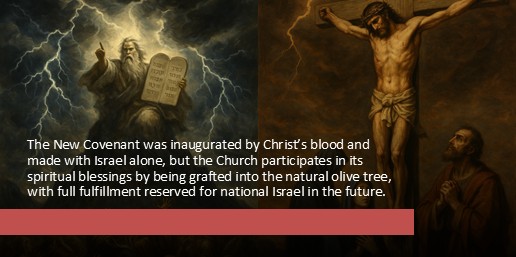
The New Covenant was inaugurated by Christ’s blood and made with Israel alone, but the Church participates in its spiritual blessings by being grafted into the natural olive tree, with full fulfillment reserved for national Israel in the future.
- God keeps every single one of His promises, even the ones that take centuries to fulfill.
- The Church is blessed to share in God’s grace through Jesus, but we don’t replace Israel.
- The best is yet to come for everyone who trusts in Jesus, both Jew and Gentile.
So, when you read about the New Covenant, don’t think of it as just “Christian talk.” It’s the unfolding of God’s faithfulness to His people; and His invitation for all to know Him through Jesus.