The subject of anointing with oil for healing raises important theological questions. What did anointing oil mean in the Old Testament? Was it medicinal, symbolic, or sacramental? What does James 5:14-15 actually promise? Does the oil itself carry power? Is healing guaranteed?
Because Scripture alone is our final authority (2 Timothy 3:16-17), we must examine the entire biblical record using a consistent historical-grammatical method. We must avoid superstition, sacramentalism, and modern innovations that go beyond what is written (1 Corinthians 4:6).
When properly understood, anointing with oil is a simple, reverent, Christ-centered act of consecration and prayer. It points us not to ritual power, but to the sovereign mercy of the Lord Jesus Christ.
1. Anointing Oil in the Old Testament Law
The Holy Anointing Oil (Exodus 30:22-33)
In the Law of Moses, God commanded a specific formula for “holy anointing oil.” It was composed of myrrh, cinnamon, calamus, cassia, and olive oil. This oil was used to consecrate:
- The Tabernacle
- The Ark
- The altar
- The priesthood
The oil was declared “holy” (Hebrew: qodesh, meaning set apart). It was not ordinary oil for common use. It symbolized consecration to God.
Importantly, the oil itself had no intrinsic power. Its meaning came from God’s command. Unauthorized duplication was forbidden. This teaches us that sacred meaning comes from divine instruction, not from mystical substance.
Oil in the Cleansing of the Leper (Leviticus 14)
In Leviticus 14, oil was used in the ceremony for a person who had already been healed of leprosy (tsara‘at). The priest applied blood and oil to the ear, thumb, and toe, then poured oil upon the head.
The order is significant:
- Blood symbolized atonement.
- Oil symbolized consecration and restoration.
The oil did not heal the leper. Healing had already occurred. The ritual confirmed cleansing and restored the individual to covenant fellowship.
Thus, oil represented restoration and acceptance before God.
Oil as a Symbol of Joy and Divine Favor
Throughout the Old Testament, oil symbolized:
- Joy (Psalms 23:5; 45:7)
- Blessing
- Empowerment
The Hebrew verb mashach means “to anoint,” from which we derive the title “Messiah,” meaning “Anointed One.” All biblical anointing ultimately points forward to Jesus Christ, the true Anointed King (Isaiah 61:1; Luke 4:18).
2. Offering or “Blessing” the Oil
In the Old Testament, sacred oil was consecrated to God before use. However, this did not mean imparting mystical power into the oil. Rather, it meant dedicating the act to the Lord.
To “bless” oil in a biblical sense is simply to:
- Set it apart for God’s purpose
- Acknowledge that healing comes from Him alone
- Pray that He would act according to His will
The power is never in the oil. It is always in the Lord.
3. Other Biblical Examples of Anointing
The Good Samaritan (Luke 10:34)
The Samaritan poured oil and wine into a wounded man’s injuries. Here oil had medicinal value. It was practical, not ceremonial.
The Disciples’ Ministry (Mark 6:13)
The apostles anointed many sick people with oil and healed them. Again, the emphasis is not on the oil, but on divine authority granted by Christ.
Oil functioned as a visible expression of dependence upon God’s healing power.
4. James 5:14-15: The New Testament Instruction
James writes:
Let us observe carefully:
- The sick person initiates the request.
- The elders respond.
- They pray.
- They anoint in the name of the Lord.
- The Lord raises up.
The focus is overwhelmingly on prayer and divine action.
5. A Biblically Faithful Description of the Ceremony
A simple, biblically accurate ceremony would include:
- The Setting – Likely in a private home or bedside setting. It is not a public spectacle. It is pastoral care.
- The Participants – Plural elders (pastor-overseers), not priests or miracle workers. Christ alone is the Mediator (1 Timothy 2:5).
- The Oil – Ordinary olive oil. No special formula. No ritual objects. It may be lightly applied to the forehead or head.
The Meaning
The oil symbolizes:
- Consecration to God
- Dependence upon Him
- A visible expression of prayer
It does not convey grace, guarantee healing, or possess inherent power.
6. The Prayer of Faith
James emphasizes prayer more than oil.
The “prayer of faith” does not mean:
- Emotional certainty of healing
- Demanding a miracle
- Declaring outcomes into existence
Biblical faith trusts God’s character and submits to His will (1 John 5:14). The elders would pray:
- In the name of Christ
- Confessing sin if necessary
- Asking for healing according to God’s will
- Entrusting the believer to divine mercy
The tone is humble, not presumptuous.
7. “Shall Save the Sick” — What Does It Mean?
The Greek word translated “save” is sōzō. It can mean:
- To save spiritually
- To rescue
- To heal
Context determines meaning. Here, James also says “the Lord shall raise him up,” which strongly indicates physical restoration. The immediate sense is bodily healing.
However, James adds: “If he have committed sins, they shall be forgiven him.”
Thus, James connects:
- Sickness
- Prayer
- Sin
- Forgiveness
- Restoration
The passage addresses the whole person, body and soul.
- Physical Healing – The primary reference is physical illness. God may restore health.
- Spiritual Restoration – If sin contributed to the affliction, forgiveness accompanies repentance.
- Ultimate Salvation – Even when physical healing does not occur, every believer will ultimately be “raised up” in resurrection glory (1 Corinthians 15).
8. Avoiding Extremes
We must avoid two errors:
- Treating oil as a guaranteed healing mechanism.
- Denying that God heals physically at all.
Scripture affirms that:
- God sometimes heals immediately.
- God sometimes grants sustaining grace instead (2 Corinthians 12:7-10).
- God always forgives the repentant believer.
- God will ultimately raise every believer in glory.
9. A Model Prayer for James 5:14
A biblically faithful prayer might sound like this:
Father in heaven,
We come in the name of the Lord Jesus Christ, who bore our sins and rose again in power.
We set apart our brother/sister to You, acknowledging that healing belongs to You alone.
If it is Your will, restore strength and health for Your glory.
Forgive any sin and grant peace and endurance.
Whether through healing or sustaining grace, may Christ be magnified.
We trust Your wise and sovereign purpose.
In Jesus’ name, Amen.
This reflects dependence, submission, and Christ-centered faith.
Conclusion
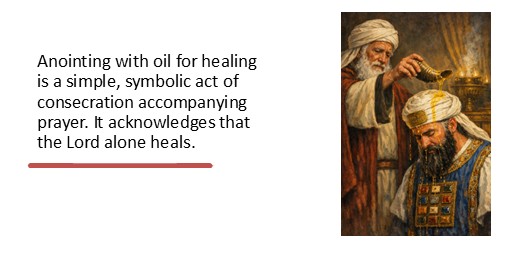
Anointing with oil for healing is not a mystical ritual. It is a simple, symbolic act of consecration accompanying prayer. It acknowledges that the Lord alone heals.
James 5:14-15 teaches that God may grant physical healing, may restore spiritually where sin is involved, and will certainly raise His people in resurrection glory.
All anointing ultimately points to Jesus Christ, the true Anointed One. He is our Healer, our Forgiver, and our Resurrection.
In Him we rest.