What Is a Mission Statement?
A mission statement is a clear, concise declaration of purpose. It defines why a person or organization exists, what they are committed to pursuing, and what ultimate goal directs their actions. A good mission statement provides focus, guards against distraction, and shapes daily decisions.
Businesses craft mission statements. Ministries write them. Leaders refine them. Why? Because clarity produces intentionality.
How much more should a Christian think carefully about the defining purpose of his or her life?
Scripture teaches that believers are not drifting through existence. We were “bought with a price” (1 Corinthians 6:20). We are “created in Christ Jesus unto good works” (Ephesians 2:10). God has saved us for a purpose.
For that reason, it is wise to prayerfully identify a defining verse, or passage, that summarizes the direction of your life under Christ. Such a verse does not replace the whole counsel of God, nor does it become a mystical slogan. Rather, it becomes a compass. It reminds you what you are living for.
When we examine the life of the Apostle Paul, we find that Philippians 3:13-14 serves as a powerful summary of his life’s direction. When read alongside Colossians 3:1-3, we see both his pursuit and the theological foundation beneath that pursuit.
Let us study these passages carefully.
Philippians 3:13-14: The Forward Pursuit
“Brethren, I count not myself to have apprehended: but this one thing I do, forgetting those things which are behind, and reaching forth unto those things which are before, I press toward the mark for the prize of the high calling of God in Christ Jesus.”
The Context of the Passage
In Philippians 3, Paul contrasts confidence in the flesh with confidence in Christ. He lists his impressive religious credentials, then declares that he counts them as loss “for the excellency of the knowledge of Christ Jesus” (Philippians 3:8).
He desires to “know him, and the power of his resurrection, and the fellowship of his sufferings” (Philippians 3:10).
Verses 13–14 summarize that desire in mission-statement form.
“This One Thing I Do”
Paul reduces his life to singular focus. He does not describe a scattered existence divided among competing ambitions. His life is not about status, comfort, reputation, or even ministry success in itself.
There is one governing pursuit.
Every believer must ask: Is my life defined by one supreme pursuit, or am I fragmented by lesser goals?
“Forgetting Those Things Which Are Behind”
The word “forgetting” does not mean erasing memory. It means refusing to be controlled by the past. Paul refuses to live under the weight of former sins, such as persecuting the church. He also refuses to rest in past accomplishments.
The Christian life is not driven by regret, nor sustained by nostalgia.
A mission-focused life cannot be anchored to yesterday.
“Reaching Forth… I Press Toward the Mark”
Paul uses athletic imagery. The phrase “reaching forth” pictures a runner straining toward the finish line. The word “press” carries the idea of pursuing with intensity.
The “mark” refers to a fixed goal. The “prize” is connected to the “high calling of God in Christ Jesus,” the upward summons that culminates in full conformity to Christ and final glorification.
Notice carefully: Paul is not pressing toward justification. He has already declared in Philippians 3:9 that righteousness comes through faith in Christ, not through the law.
Salvation is by grace through faith alone in the finished work of Christ (Ephesians 2:8-9; 1 Corinthians 15:1-4).
What Paul is describing is sanctification, the Spirit-empowered pursuit of Christlikeness, grounded in a secure salvation.
His mission statement could be summarized this way:
But what makes such pursuit possible?
For that, we turn to Colossians 3.
Colossians 3:1-3: The Foundation of the Pursuit
“If ye then be risen with Christ, seek those things which are above, where Christ sitteth on the right hand of God. Set your affection on things above, not on things on the earth. For ye are dead, and your life is hid with Christ in God.”
Position Before Command
Paul begins with identity.
“If ye then be risen with Christ…”
This refers to the believer’s union with Christ in His resurrection. At the moment of salvation, the Holy Spirit spiritually baptizes the believer into Christ (1 Corinthians 12:13). The old life under sin’s dominion is decisively broken, and a new life begins (Romans 6:3-4).
Only after stating this positional truth does Paul command:
“Seek those things which are above.”
The order is critical. We do not seek heavenly things to become risen with Christ. We seek heavenly things because we are risen with Christ.
Identity fuels mission.
A Heavenly Orientation
Christ is presently seated “on the right hand of God,” a position of authority and completed redemptive work (Hebrews 10:12).
Believers are commanded to set their affection, their mindset, their orientation, on what is above.
This parallels Philippians 3:14. The prize is upward. The calling is upward. The direction is upward.
Paul’s mission was not earth-bound. It was Christ-bound.
“Ye Are Dead… Your Life Is Hid”
“For ye are dead, and your life is hid with Christ in God.”
The believer is dead to the old realm of sin and self-rule. Our true life is hidden with Christ. The verb indicates a settled reality. It speaks of security.
This guards against legalism and despair.
We do not press forward to secure salvation. Our life is already hidden in Christ. We press forward because our life is secure in Him.
- Colossians 3 shows the runner’s identity and emphasizes position
- Philippians 3 shows the race and emphasizes pursuit.
Together, they form Paul’s mission theology.
The Integrated Mission of Paul
When these passages are read together, Paul’s mission becomes clear:
- He is united to the risen Christ.
- His true life is secured in Christ.
- Therefore, he seeks what is above.
- He presses toward full conformity to Christ.
- He lives in light of the upward call and future glorification.
This is not mystical speculation. It is grounded in the historical, bodily resurrection of Jesus Christ. The same Christ who died for our sins and rose again (1 Corinthians 15:3-4) now sits at the right hand of the Father and will return personally and visibly (Philippians 3:20-21).
Paul’s mission is anchored in Christ’s finished work and directed toward Christ’s coming kingdom.
Applying This to Your Life
It is wise and biblically healthy to identify a defining passage that captures your life’s direction under Christ. This does not replace obedience to the whole Word of God. It clarifies your focus.
A defining verse:
- Clarifies purpose.
- Filters distractions.
- Strengthens perseverance.
- Guards against worldliness.
- Reminds you of eternity.
If Philippians 3:13-14 were adopted as a personal mission statement, it would mean:
- I will not be defined by my past.
- I will not live for earthly applause.
- I will pursue Christ above all else.
- I will live for the upward call of God.
And if grounded in Colossians 3:1-3, it would mean:
- I pursue Christ because I belong to Christ.
- I seek what is above because my life is hidden above.
- I press forward because my future is secure.
Conclusion
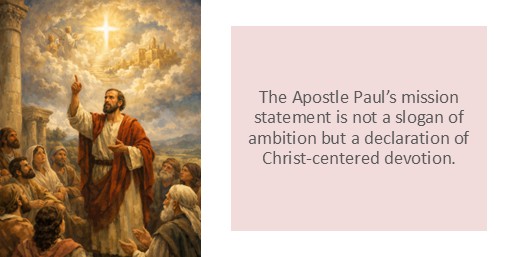
The Apostle Paul’s mission statement is not a slogan of ambition but a declaration of Christ-centered devotion.
- Philippians 3:13-14 reveals the direction of his life: pressing toward the upward call.
- Colossians 3:1-3 reveals the foundation of his life: union with the risen Christ.
For every believer, the question remains:
What governs your life?
If you are in Christ by grace through faith, your life is already hidden with Him. The upward call awaits. The race is not finished.
May it be said of us, as it was of Paul, that we pressed toward the mark for the prize of the high calling of God in Christ Jesus.